Ch. 15 - Reactions of Carboxylic Acids and Carboxylic Acid Derivatives
Bruice - Organic Chemistry 8th Edition
Bruice8th EditionOrganic ChemistryISBN: 9780135213711Not the one you use?Change textbook
Chapter 16, Problem 38a

What alkyl bromide would you use in a Gabriel synthesis to prepare each of the following amines?
a. pentylamine

Verified step by step guidance
1
Understand the Gabriel synthesis: It is a method used to prepare primary amines by reacting a phthalimide anion with an alkyl halide, followed by hydrolysis or hydrazinolysis to release the amine.
Identify the target amine: The target amine in this case is pentylamine, which has the structure CH3-(CH2)4-NH2. This is a primary amine with a five-carbon chain.
Determine the alkyl bromide needed: In the Gabriel synthesis, the alkyl bromide provides the carbon chain that becomes part of the amine. To form pentylamine, the alkyl bromide must have a five-carbon chain and no functional groups other than the bromine. The structure of the alkyl bromide would be CH3-(CH2)4-Br (1-bromopentane).
Write the reaction sequence: The phthalimide anion (generated by treating phthalimide with a strong base like KOH) reacts with 1-bromopentane in an SN2 reaction to form an N-alkylphthalimide intermediate.
Explain the final step: The N-alkylphthalimide is then hydrolyzed (using aqueous acid or base) or treated with hydrazine to release the primary amine, pentylamine, and regenerate the phthalimide.

Verified video answer for a similar problem:

This video solution was recommended by our tutors as helpful for the problem above.
Video duration:
2m
Was this helpful?

Key Concepts

Here are the essential concepts you must grasp in order to answer the question correctly.

Gabriel Synthesis

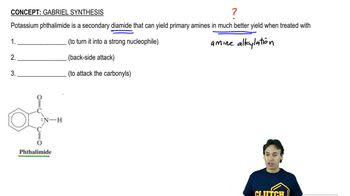
Gabriel synthesis is a method for preparing primary amines from alkyl halides using phthalimide as a nucleophile. The process involves the nucleophilic substitution of the alkyl halide with the phthalimide, followed by hydrolysis to yield the desired amine. This method is particularly useful because it avoids the formation of secondary or tertiary amines, ensuring that only primary amines are produced.
Recommended video:
Guided course
04:53
General Reaction

Alkyl Halides

Alkyl halides are organic compounds containing a carbon chain bonded to a halogen atom (such as bromine, chlorine, or iodine). In the context of Gabriel synthesis, the choice of alkyl halide is crucial, as it determines the structure of the resulting amine. The reactivity of the alkyl halide also influences the efficiency of the nucleophilic substitution reaction, with primary alkyl halides being the most favorable for this synthesis.
Recommended video:
Guided course
01:52
How to name alkyl halides

Nucleophilic Substitution

Nucleophilic substitution is a fundamental reaction in organic chemistry where a nucleophile attacks an electrophilic carbon atom, resulting in the replacement of a leaving group. In Gabriel synthesis, the nucleophile (phthalimide) attacks the carbon of the alkyl halide, leading to the formation of a new carbon-nitrogen bond. Understanding the mechanisms of nucleophilic substitution, including factors that affect reactivity and selectivity, is essential for predicting the outcomes of such reactions.
Recommended video:
Guided course
01:47
Nucleophiles and Electrophiles can react in Substitution Reactions.