Give the structure of the molecule that gives rise to the following IR and mass spectra. <IMAGE>
Verified step by step guidance
1
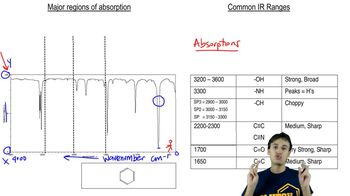
Examine the IR spectrum for characteristic peaks. Look for broad peaks around 3300 cm-1 which indicate O-H or N-H bonds, sharp peaks around 1700 cm-1 for C=O bonds, and peaks around 1600 cm-1 for C=C bonds.
Identify the functional groups present in the molecule based on the IR spectrum. For example, a peak around 1700 cm-1 suggests a carbonyl group, while a broad peak around 3300 cm-1 suggests an alcohol or amine.
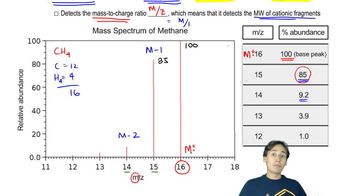
Analyze the mass spectrum to determine the molecular weight of the compound. The peak with the highest m/z value is typically the molecular ion peak, which gives the molecular weight of the compound.
Look for fragmentation patterns in the mass spectrum that can provide clues about the structure of the molecule. Common fragments can indicate the presence of certain functional groups or structural features.
Combine the information from the IR and mass spectra to propose a structure for the molecule. Consider the molecular weight, functional groups, and any fragmentation patterns to deduce the most likely structure.
Verified video answer for a similar problem:
This video solution was recommended by our tutors as helpful for the problem above
Video duration:
7m
Play a video:
0 Comments
Key Concepts
Here are the essential concepts you must grasp in order to answer the question correctly.
Infrared (IR) Spectroscopy
IR spectroscopy is a technique used to identify functional groups in a molecule by measuring the absorption of infrared light at different wavelengths. The resulting spectrum shows peaks corresponding to the vibrational frequencies of bonds within the molecule. Key regions include the O-H stretch around 3200-3600 cm⁻¹, C=O stretch near 1700 cm⁻¹, and C-H stretches around 2800-3000 cm⁻¹.
Mass spectrometry is an analytical technique used to determine the molecular weight and structure of a compound by ionizing chemical species and sorting the ions based on their mass-to-charge ratio (m/z). The spectrum displays peaks that represent fragments of the molecule, with the highest m/z peak often corresponding to the molecular ion, providing insight into the molecular weight of the compound.
Identifying functional groups is crucial for determining the structure of a molecule. In IR spectroscopy, specific absorption bands correspond to different functional groups, such as alcohols, carbonyls, and amines. By analyzing these bands, one can deduce the presence of certain functional groups, which, combined with mass spectrometry data, helps in constructing the molecular structure.