Ch.1 - Structure and Bonding
Wade - Organic Chemistry 9th Edition
Wade9th EditionOrganic ChemistryISBN: 9780135213728Not the one you use?Change textbook
Chapter 1, Problem 55e

Draw orbital pictures of the pi bonding in the following compounds:
e. CH3CH=C=CHCH3

Verified step by step guidance
1
Identify the structure of the compound CH3CH=C=CHCH3. This compound is known as 2,3-pentadiene, which contains two double bonds between carbon atoms.
Recognize that each double bond consists of one sigma (σ) bond and one pi (π) bond. The pi bond is formed by the sideways overlap of p orbitals.
For the first double bond (CH3CH=C), identify the carbon atoms involved in the pi bond. These are the second and third carbon atoms in the chain.
Draw the p orbitals on the second and third carbon atoms. These p orbitals will overlap sideways to form the first pi bond.
Repeat the process for the second double bond (C=CHCH3), involving the third and fourth carbon atoms. Draw the p orbitals on these carbon atoms and show their sideways overlap to form the second pi bond.

Verified video answer for a similar problem:

This video solution was recommended by our tutors as helpful for the problem above.
Video duration:
3m
Was this helpful?

Key Concepts

Here are the essential concepts you must grasp in order to answer the question correctly.

Pi Bonding

Pi bonds are formed by the sideways overlap of p orbitals, which are not involved in sigma bonding. In a molecule, pi bonds provide additional bonding strength and are typically found in double and triple bonds. Understanding pi bonding is crucial for visualizing the electron cloud distribution in unsaturated hydrocarbons like alkenes and alkynes.
Recommended video:
Guided course
01:05
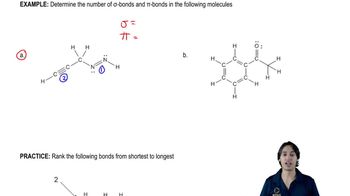
Sigma bonds and pi bonds

Orbital Hybridization

Orbital hybridization involves the mixing of atomic orbitals to form new hybrid orbitals, which can form sigma and pi bonds. In the compound CH3CH=C=CHCH3, the central carbon atoms are sp2 and sp hybridized, allowing for the formation of both sigma and pi bonds. Recognizing the hybridization state helps in predicting the geometry and bonding of the molecule.
Recommended video:
Guided course
04:58
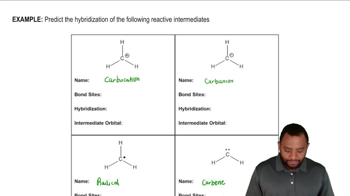
Bond sites, hybridization, and intermediate orbitals

Molecular Geometry

Molecular geometry refers to the three-dimensional arrangement of atoms in a molecule. It is determined by the hybridization of the central atoms and the presence of pi bonds. For CH3CH=C=CHCH3, understanding the linear and trigonal planar geometries around the sp and sp2 hybridized carbons is essential for accurately drawing the orbital pictures of pi bonding.
Recommended video:
Guided course
07:44
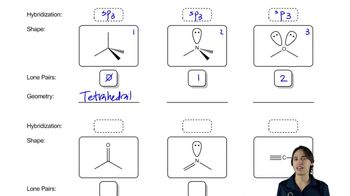
Molecular Geometry Explained.