
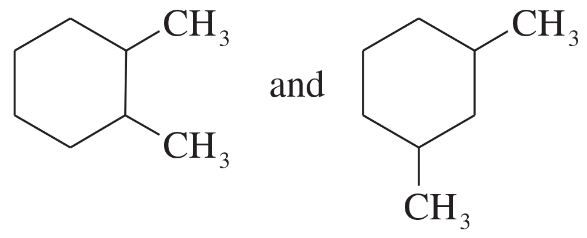
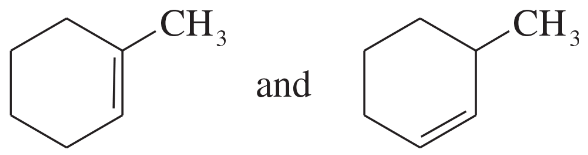
Give the relationship between the following pairs of structures. The possible relationships are:
same compound
constitutional isomers (structural isomers)
cis-trans isomers
not isomers (different molecular formula)
(a)
(b)
(c)
Verified step by step guidance
Give the relationship between the following pairs of structures. The possible relationships are:
same compound
constitutional isomers (structural isomers)
cis-trans isomers
not isomers (different molecular formula)
(a)
(b)
(c)
Give the relationship between the following pairs of structures. The possible relationships are:
same compound
constitutional isomers (structural isomers)
cis-trans isomers
not isomers (different molecular formula)
(g) CH3–CH2–CH2–CH3 and CH3–CH=CH–CH3
(h) CH2=CH–CH2CH2CH3 and CH3–CH=CH–CH2CH3
(i) CH2=CHCH2CH2CH3 and CH3CH2CH2CH=CH2
a. Draw the resonance forms for SO2 (bonded O–S–O).
Which of the following compounds show cis-trans isomerism? Draw the cis and trans isomers of those that do.
(a) CHF=CHF
(b) F2C=CH2
(c) CH2=CH–CH2–CH3
Name the element that corresponds to each electronic configuration.
a. 1s2 2s2 2p2
b. 1s2 2s2 2p4
c. 1s2 2s2 2p6 3s2 3p3
d. 1s2 2s2 2p6 3s2 3p5
b. Draw the resonance forms for ozone (bonded O–O–O)
c. Sulfur dioxide has one more resonance form than ozone. Explain why this structure is not possible for ozone.