Ch. 10 - Alkynes: Electrophilic Addition and Redox Reactions
Mullins - Organic Chemistry: A Learner Centered Approach 1st Edition
Mullins1st EditionOrganic Chemistry: A Learner Centered ApproachISBN: 9780137566471Not the one you use?Change textbook
Chapter 9, Problem 44c(iv)

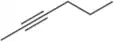
For the alkynes shows here, show the product(s) expected to form when treated under the following conditions: (iv) HBr (1 equiv.). If you expect two products, show both.
(c) Diagram of alkynes showing expected products from hydrogenation with H₂ and Pd/C catalyst.

Verified step by step guidance
1
Identify the structure of the alkyne provided in part (c). Determine whether it is a terminal alkyne (with a hydrogen at one end) or an internal alkyne (with substituents on both sides of the triple bond). This will influence the regioselectivity of the reaction.
Recall the reaction mechanism for the addition of HBr to an alkyne. The reaction proceeds via Markovnikov addition, where the hydrogen atom from HBr adds to the carbon of the triple bond that already has more hydrogens, and the bromine atom adds to the other carbon.
Since only 1 equivalent of HBr is used, the reaction will stop at the alkene stage, forming a bromoalkene. The triple bond will be converted into a double bond, and the bromine will be added to the more substituted carbon (Markovnikov's rule).
If the alkyne is unsymmetrical, consider the possibility of regioisomers. Draw both potential products if applicable, showing the placement of the bromine atom and the double bond in each case.
Verify the stereochemistry of the product(s). For alkynes, the addition of HBr does not typically lead to stereoisomers because the reaction proceeds through a planar carbocation intermediate. Ensure the final product(s) are drawn correctly with the double bond and bromine in the appropriate positions.

Verified video answer for a similar problem:

This video solution was recommended by our tutors as helpful for the problem above.
Video duration:
5m
Was this helpful?

Key Concepts

Here are the essential concepts you must grasp in order to answer the question correctly.

Alkynes

Alkynes are hydrocarbons that contain at least one carbon-carbon triple bond. They are unsaturated compounds and are generally more reactive than alkenes and alkanes due to the presence of the triple bond. The reactivity of alkynes allows them to undergo various addition reactions, which is crucial for predicting the products formed when they react with reagents like HBr.
Recommended video:
Guided course
09:11
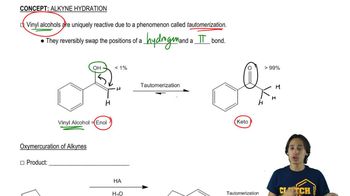
Alkyne Hydration

Electrophilic Addition

Electrophilic addition is a reaction mechanism where an electrophile reacts with a nucleophile, leading to the formation of a more saturated product. In the case of alkynes reacting with HBr, the triple bond acts as a nucleophile, attacking the electrophilic hydrogen atom of HBr. This reaction can lead to the formation of either a vinyl bromide or a bromoalkane, depending on the reaction conditions and the regioselectivity of the addition.
Recommended video:
Guided course
09:23
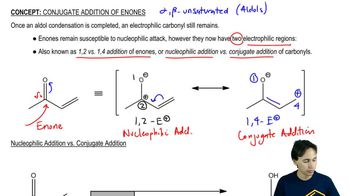
1,2 vs 1,4 Addition

Markovnikov's Rule

Markovnikov's Rule states that when HX (where X is a halogen) adds to an alkene or alkyne, the hydrogen atom will attach to the carbon with the greater number of hydrogen atoms already attached. This rule helps predict the major product in reactions involving unsymmetrical alkynes. In the case of HBr addition to an alkyne, this rule can lead to the formation of two different products, depending on the regioselectivity of the addition.
Recommended video:
Guided course
03:54
The 18 and 16 Electron Rule