Ch. 16 - Aromatic Compounds
Wade - Organic Chemistry 9th Edition
Wade9th EditionOrganic ChemistryISBN: 9780135213728Not the one you use?Change textbook
Chapter 16, Problem 34a,b,c

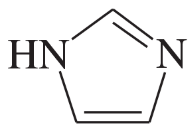
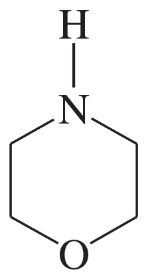
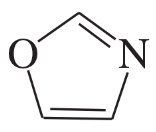
Each of the following heterocycles includes one or more nitrogen atoms. Classify each nitrogen atom as strongly basic or weakly basic, according to the availability of its lone pair of electrons.
(a)
(b)
(c)

Verified step by step guidance
1
Step 1: Analyze the nitrogen atoms in structure (i). The molecule is a pyrimidine derivative. The nitrogen atom with the methyl group attached has its lone pair localized and not involved in resonance with the aromatic ring, making it strongly basic. The other nitrogen atom has its lone pair delocalized into the aromatic ring, making it weakly basic.
Step 2: Examine the nitrogen atom in structure (ii). This molecule is a morpholine derivative. The nitrogen atom has its lone pair localized and not involved in resonance or conjugation with the oxygen atom or the ring system, making it strongly basic.
Step 3: Evaluate the nitrogen atom in structure (iii). This molecule is an oxazole derivative. The nitrogen atom has its lone pair delocalized into the aromatic ring system, making it weakly basic.
Step 4: Consider the role of resonance and aromaticity in determining the basicity of nitrogen atoms. Lone pairs that are delocalized into aromatic systems are less available for protonation, reducing basicity. Lone pairs that are localized and not involved in resonance are more available for protonation, increasing basicity.
Step 5: Summarize the classifications: (i) one strongly basic nitrogen and one weakly basic nitrogen, (ii) strongly basic nitrogen, (iii) weakly basic nitrogen.

Verified video answer for a similar problem:

This video solution was recommended by our tutors as helpful for the problem above.
Video duration:
10m
Was this helpful?

Key Concepts

Here are the essential concepts you must grasp in order to answer the question correctly.

Basicity of Nitrogen

Basicity in organic chemistry refers to the ability of a compound to accept protons (H+). Nitrogen atoms can exhibit basicity due to the presence of a lone pair of electrons. The strength of basicity is influenced by the availability of this lone pair; if it is readily available for bonding with protons, the nitrogen is considered strongly basic.
Recommended video:
Guided course
06:21
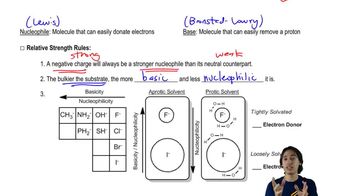
Understanding the difference between basicity and nucleophilicity.

Aromaticity and Electron Delocalization

Aromatic compounds are characterized by a cyclic structure with conjugated pi electrons that are delocalized across the ring. This delocalization can stabilize the molecule but also affects the availability of lone pairs on heteroatoms like nitrogen. In aromatic systems, lone pairs may participate in resonance, reducing their availability for protonation and thus weakening basicity.
Recommended video:
Guided course
08:19
Intro to Aromaticity

Inductive and Resonance Effects

Inductive effects arise from the electronegativity of atoms within a molecule, influencing the electron density around the nitrogen atom. Resonance effects occur when lone pairs can be delocalized into a pi system. Both effects can either enhance or diminish the basicity of nitrogen atoms, depending on their structural context within the heterocycle.
Recommended video:
Guided course
01:47
Understanding the Inductive Effect.