Ch. 16 - Reactions of Aldehydes and Ketones • More Reactions of Carboxylic Acid Derivatives
Bruice - Organic Chemistry 8th Edition
Bruice8th EditionOrganic ChemistryISBN: 9780135213711Not the one you use?Change textbook
Chapter 17, Problem 35b

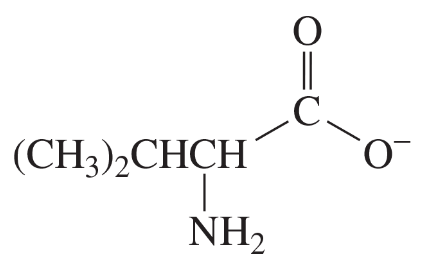
The compounds commonly known as 'amino acids' are actually α-aminocarboxylic-aminocarboxylic acids. What carbonyl compounds should be used to synthesize the two amino acids shown here?
b. Chemical structure of an α-aminocarboxylic acid with a carboxylate group and an amine group attached.

Verified step by step guidance
1
Step 1: Identify the amino acid structure shown in the image. The compound has an amino group (-NH2) attached to the α-carbon, a carboxylate group (-COO⁻), and a benzyl side chain (a phenyl group attached to a CH2 group). This structure corresponds to the amino acid phenylalanine.
Step 2: Recall the Strecker synthesis, a common method for synthesizing α-amino acids. In this method, an aldehyde reacts with ammonia and hydrogen cyanide to form an α-aminonitrile, which is then hydrolyzed to yield the α-amino acid.
Step 3: Determine the carbonyl compound needed for the synthesis. The side chain of phenylalanine (a benzyl group) suggests that the starting carbonyl compound should be benzaldehyde (C6H5CHO), which has a phenyl group directly attached to the aldehyde functional group.
Step 4: Write the reaction sequence. Benzaldehyde reacts with ammonia (NH3) and hydrogen cyanide (HCN) to form phenylaminonitrile. This intermediate is then hydrolyzed under acidic or basic conditions to yield phenylalanine.
Step 5: Summarize the synthesis. The carbonyl compound required to synthesize phenylalanine is benzaldehyde. This compound undergoes the Strecker synthesis to produce the desired amino acid.

Verified video answer for a similar problem:

This video solution was recommended by our tutors as helpful for the problem above.
Video duration:
4m
Was this helpful?

Key Concepts

Here are the essential concepts you must grasp in order to answer the question correctly.

Amino Acids

Amino acids are organic compounds that serve as the building blocks of proteins. They contain both an amine group (-NH2) and a carboxylic acid group (-COOH), making them α-aminocarboxylic acids. The structure of amino acids allows them to participate in various biochemical reactions, including protein synthesis and enzyme activity.
Recommended video:
Guided course
09:36
Standard Amino Acids

Carbonyl Compounds

Carbonyl compounds are organic molecules that contain a carbonyl group (C=O), which is a carbon atom double-bonded to an oxygen atom. They are classified into aldehydes and ketones, depending on the position of the carbonyl group. In the synthesis of amino acids, carbonyl compounds can react with amines to form amino acids through processes such as reductive amination.
Recommended video:
Guided course
01:40
Defining meso compounds.

Synthesis of Amino Acids

The synthesis of amino acids often involves the reaction of carbonyl compounds with amines. This can occur through various methods, including the Strecker synthesis and Gabriel synthesis. Understanding the specific carbonyl compounds needed for synthesizing particular amino acids is crucial for organic synthesis and biochemistry, as it allows for the production of these essential biomolecules.
Recommended video:
1:16
Synthesis of Amino Acids: Strecker Synthesis Example 1