Threonine, an amino acid, has four stereoisomers. The stereoisomer found in nature is (2S,3R)-threonine. Which of the following structures represents the naturally occurring amino acid?
Verified step by step guidance
1
Step 1: Understand the stereochemical notation (2S,3R) for threonine. The '2S' refers to the configuration of the second carbon in the chain, and '3R' refers to the configuration of the third carbon. These configurations are determined using the Cahn-Ingold-Prelog priority rules.
Step 2: Analyze the structure of threonine. Threonine is an amino acid with a hydroxyl group (-OH) on the third carbon and an amino group (-NH2) on the second carbon. The carboxylic acid group (-COOH) is attached to the first carbon.
Step 3: Apply the Cahn-Ingold-Prelog priority rules to each stereocenter in the given structures. Assign priorities based on atomic number and connectivity to determine the stereochemical configuration (R or S) for each carbon.
Step 4: Compare the stereochemical configurations of the given structures (A, B, C, D) with the (2S,3R) configuration of naturally occurring threonine. Identify the structure where the second carbon is 'S' and the third carbon is 'R'.
Step 5: Select the correct structure that matches the (2S,3R) configuration. Verify that the spatial arrangement of groups (amino, hydroxyl, carboxylic acid, and hydrogen) aligns with the natural stereoisomer.
Verified video answer for a similar problem:
This video solution was recommended by our tutors as helpful for the problem above
Video duration:
11m
Play a video:
0 Comments
Key Concepts
Here are the essential concepts you must grasp in order to answer the question correctly.
Stereoisomerism
Stereoisomerism refers to the phenomenon where molecules have the same molecular formula and connectivity of atoms but differ in the spatial arrangement of their atoms. In amino acids, this is particularly important as they can exist as different stereoisomers, which can have distinct biological functions. The two main types of stereoisomers are enantiomers, which are non-superimposable mirror images, and diastereomers, which are not mirror images.
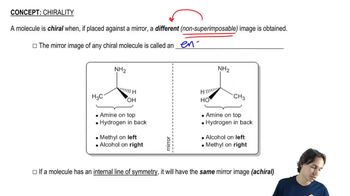
Chirality is a property of a molecule that makes it non-superimposable on its mirror image, often due to the presence of one or more chiral centers. A chiral center typically involves a carbon atom bonded to four different substituents. In the case of threonine, it has two chiral centers, leading to four possible stereoisomers, each with unique spatial configurations that affect their interactions in biological systems.
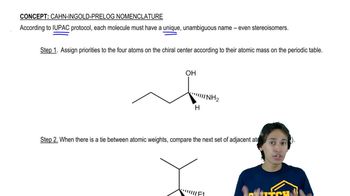
The Cahn-Ingold-Prelog (CIP) priority rules are a set of guidelines used to assign the configuration of chiral centers in stereoisomers. These rules help determine the priority of substituents based on atomic number and connectivity. By applying these rules, one can designate the stereochemistry of a chiral center as either 'R' (rectus) or 'S' (sinister), which is crucial for identifying the correct stereoisomer of threonine that occurs naturally.