Textbook Question
Calculate the energy difference between each pair of conformations shown by drawing and comparing Newman projections down the indicated bonds in each.
(b)
1
views

 Mullins 1st EditionCh. 3 - Alkanes and Cycloalkanes: Properties and Conformational AnalysisProblem 67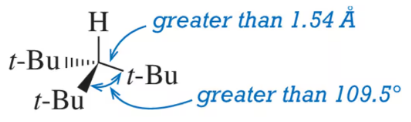
 Verified step by step guidance
 10:43
10:43
 02:53
02:53 02:04
02:04Calculate the energy difference between each pair of conformations shown by drawing and comparing Newman projections down the indicated bonds in each.
(b)
In Chapter 5, we introduce reaction coordinate diagrams as a plot of potential energy versus the progress of a reaction. Consider the reaction coordinate diagram drawn for the 'reaction' of conformation A becoming conformation B. Which structure is present at the top of the hill?
<IMAGE>
Correct the following incorrect names using standard IUPAC nomenclature. [Draw a compound that corresponds to the incorrect name, and then rename it.]
(a) 4-methylhexane
In contrast to ethane and other alkanes studied in this chapter, there is no free rotation around any bonds in cyclopentane (shown below). Why?
Looking ahead In Chapter 5, we explain that the equilibrium constant (Keq) for a reaction can be calculated based on the difference in energy between reactants and products, according to the following equation:
Using this equation, calculate the equilibrium constant for the 'reaction' shown. [For the rest of the book, if not otherwise specified, assume room temperature (298K).]
Correct the following incorrect names using standard IUPAC nomenclature. [Draw a compound that corresponds to the incorrect name, and then rename it.]
(b) 1,5-dimethylcyclohexane