Ch. 22 - Condensations and Alpha Substitutions of Carbonyl Compounds
Wade - Organic Chemistry 9th Edition
Wade9th EditionOrganic ChemistryISBN: 9780135213728Not the one you use?Change textbook
Chapter 22, Problem 79a

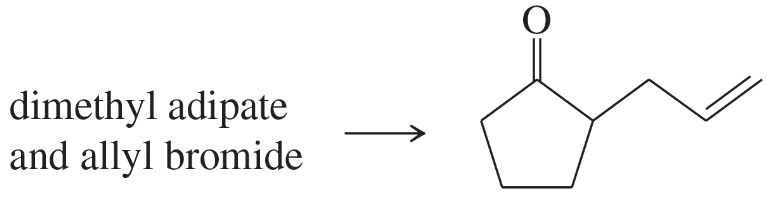
Show how you would accomplish the following multistep conversions. You may use any additional reagents you need.
(a)

Verified step by step guidance
1
Analyze the starting material and the target molecule to identify the functional groups present in each. Determine the changes that need to occur (e.g., addition, elimination, oxidation, reduction, etc.).
Break the transformation into smaller, manageable steps. For example, if the target molecule requires a functional group that is not present in the starting material, consider introducing it through a reaction such as halogenation, hydroboration, or oxidation.
Select appropriate reagents and reaction conditions for each step. For example, if you need to convert an alcohol to a ketone, you might use an oxidizing agent like PCC (Pyridinium chlorochromate).
Ensure that the sequence of reactions is logical and avoids side reactions. For instance, if a protecting group is needed to prevent unwanted reactions, include it in the sequence and plan for its removal later.
Write out the reaction mechanism for each step to confirm that the proposed reagents and conditions will lead to the desired intermediate or final product. This will help ensure the feasibility of the multistep synthesis.

Verified video answer for a similar problem:

This video solution was recommended by our tutors as helpful for the problem above.
Video duration:
4m
Was this helpful?

Key Concepts

Here are the essential concepts you must grasp in order to answer the question correctly.

Reaction Mechanisms

Understanding reaction mechanisms is crucial in organic chemistry as they describe the step-by-step process by which reactants transform into products. This includes identifying intermediates, transition states, and the types of bonds formed or broken. A clear grasp of mechanisms helps predict the outcome of reactions and the conditions required for them.
Recommended video:
Guided course
02:16
Heck Reaction Mechanism

Functional Groups

Functional groups are specific groups of atoms within molecules that are responsible for the characteristic chemical reactions of those molecules. Recognizing functional groups is essential for predicting reactivity and determining the appropriate reagents for conversions. Common functional groups include alcohols, amines, and carboxylic acids, each with unique properties and reactivity patterns.
Recommended video:
Guided course
02:36
Identifying Functional Groups

Reagents and Conditions

The choice of reagents and reaction conditions is vital in organic synthesis, as they dictate the course and efficiency of a reaction. Different reagents can facilitate various transformations, such as oxidation, reduction, or substitution. Understanding how to select and apply the right reagents and conditions is key to successfully achieving the desired multistep conversions.
Recommended video:
Related Practice
Textbook Question

Many of the condensations we have studied are reversible. The reverse reactions are often given the prefix retro-, the Latin word meaning “backward.” Propose mechanisms to account for the following reactions.

(b)

5
views

Textbook Question

Many of the condensations we have studied are reversible. The reverse reactions are often given the prefix retro-, the Latin word meaning “backward.” Propose mechanisms to account for the following reactions.

(c)

1
views
Textbook Question

Write equations showing the expected products of the following enamine alkylation and acylation reactions. Then give the final products expected after hydrolysis of the iminium salts.

(d) piperidine enamine of cyclopentanone + methyl vinyl ketone

5
views
Textbook Question

Write equations showing the expected products of the following enamine alkylation and acylation reactions. Then give the final products expected after hydrolysis of the iminium salts.

(c) piperidine enamine of cyclopentanone + methyl iodide

1
views
Textbook Question

Write equations showing the expected products of the following enamine alkylation and acylation reactions. Then give the final products expected after hydrolysis of the iminium salts.

(a) pyrrolidine enamine of pentan-3-one + allyl chloride

(b) pyrrolidine enamine of acetophenone + butanoyl chloride

Textbook Question

Many of the condensations we have studied are reversible. The reverse reactions are often given the prefix retro-, the Latin word meaning “backward.” Propose mechanisms to account for the following reactions.

(a)

1
views