
Ch. 16 - Aromatic Compounds
Wade - Organic Chemistry 9th Edition
Wade9th EditionOrganic ChemistryISBN: 9780135213728Not the one you use?Change textbook
Chapter 16, Problem 37b

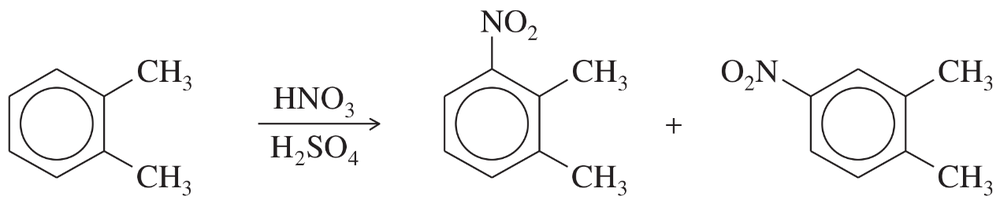
Before spectroscopy was invented, Körner’s absolute method was used to determine whether a disubstituted benzene derivative was the ortho, meta, or para isomer. Körner’s method involves adding a third group (often a nitro group) and determining how many isomers are formed. For example, when o-xylene is nitrated (by a method shown in Chapter 17), two isomers are formed.

b. How many isomers are formed by nitration of p-xylene?

Verified step by step guidance
1
Step 1: Understand the nitration reaction. Nitration involves the addition of a nitro group (-NO₂) to an aromatic ring. This is typically achieved using a mixture of concentrated nitric acid (HNO₃) and sulfuric acid (H₂SO₄), which generates the nitronium ion (NO₂⁺), the electrophile responsible for the reaction.
Step 2: Analyze the structure of p-xylene. p-Xylene is a benzene ring with two methyl groups (-CH₃) attached at the para positions (1,4 positions). The symmetry of the molecule plays a key role in determining the number of isomers formed during nitration.
Step 3: Predict the positions where the nitro group can be added. In p-xylene, the methyl groups are electron-donating and activate the benzene ring, making the ortho and para positions relative to each methyl group more reactive. However, due to the symmetry of p-xylene, the addition of a nitro group will result in identical products at certain positions.
Step 4: Consider the symmetry of the molecule. Because p-xylene is symmetric, nitration at the ortho position relative to either methyl group will produce the same compound. Similarly, nitration at the para position relative to one methyl group will produce a single unique compound. Thus, only two distinct isomers can be formed.
Step 5: Conclude the number of isomers. Based on the analysis, nitration of p-xylene results in two distinct isomers due to the symmetry of the molecule and the activation effects of the methyl groups.

Verified video answer for a similar problem:

This video solution was recommended by our tutors as helpful for the problem above.
Video duration:
2m
Was this helpful?

Key Concepts

Here are the essential concepts you must grasp in order to answer the question correctly.

Disubstituted Benzene Isomers

Disubstituted benzene compounds can exist in three distinct isomeric forms: ortho, meta, and para. These terms refer to the relative positions of the substituents on the benzene ring. Understanding these isomers is crucial for predicting the outcomes of chemical reactions, such as nitration, which can yield different products based on the starting isomer.
Recommended video:
Guided course
09:04
Benzene Nomenclature

Nitration Reaction

Nitration is an electrophilic aromatic substitution reaction where a nitro group (NO2) is introduced into an aromatic compound. The reaction typically involves the use of a nitrating mixture, such as concentrated nitric acid and sulfuric acid. The position of the nitro group in the product depends on the original substituents on the benzene ring, influencing the number of isomers formed.
Recommended video:
Guided course
06:09
EAS Nitration

Körner’s Absolute Method

Körner’s absolute method is a historical technique used to determine the structure of disubstituted benzene derivatives by introducing a third substituent and analyzing the resulting isomers. By observing how many isomers are produced upon nitration, chemists can infer the original positions of the substituents. This method provides insight into the reactivity and orientation of substituents in aromatic compounds.
Recommended video:
1:24
Amino Acid Synthesis: HVZ Method Concept 1
Related Practice
Textbook Question

Before spectroscopy was invented, Körner’s absolute method was used to determine whether a disubstituted benzene derivative was the ortho, meta, or para isomer. Körner’s method involves adding a third group (often a nitro group) and determining how many isomers are formed. For example, when o-xylene is nitrated (by a method shown in Chapter 17), two isomers are formed.

a. How many isomers are formed by nitration of m-xylene?

1
views
Textbook Question

For each NMR spectrum, propose a structure consistent with the spectrum and the additional information provided.

<IMAGE>

a. Elemental analysis shows the molecular formula to be C8H7OCl. The IR spectrum shows a moderate absorption at 1602 cm–1 and a strong absorption at 1690 cm–1.

b. The mass spectrum shows a double molecular ion of ratio 1:1 at m/z 184 and 186.

<IMAGE>

1
views
Textbook Question

The benzene ring alters the reactivity of a neighboring group in the benzylic position much as a double bond alters the reactivity of groups in the allylic position.

Benzylic cations, anions, and radicals are all more stable than simple alkyl intermediates.

b. Toluene reacts with bromine in the presence of light to give benzyl bromide. Propose a mechanism for this reaction.

1
views
Textbook Question

The benzene ring alters the reactivity of a neighboring group in the benzylic position much as a double bond alters the reactivity of groups in the allylic position.

Benzylic cations, anions, and radicals are all more stable than simple alkyl intermediates.

c. Which of the following reactions will have the faster rate and give the better yield? Use a drawing of the transition state to explain your answer.

2
views
Textbook Question

Before spectroscopy was invented, Körner’s absolute method was used to determine whether a disubstituted benzene derivative was the ortho, meta, or para isomer. Körner’s method involves adding a third group (often a nitro group) and determining how many isomers are formed. For example, when o-xylene is nitrated (by a method shown in Chapter 17), two isomers are formed.

c. A turn-of-the-century chemist isolated an aromatic compound of molecular formula C6H4Br2. He carefully nitrated this compound and purified three isomers of formula C6H3Br2NO2. Propose structures for the original compound and the three nitrated derivatives

1
views
Textbook Question

Recall (Section 16-10) that two positions of anthracene sometimes react more like polyenes than like aromatic compounds.

b. The Diels–Alder reaction of anthracene with maleic anhydride is a common organic lab experiment. Predict the product of this Diels–Alder reaction.

2
views