
Ch.5 - Stereochemistry
Wade - Organic Chemistry 9th Edition
Wade9th EditionOrganic ChemistryISBN: 9780135213728Not the one you use?Change textbook
Chapter 5, Problem 23

Draw the mirror images of glucose and fructose. Are glucose and fructose chiral? Do you expect them to be optically active?

Verified step by step guidance
1
Draw the Fischer projection of D-glucose, which is an aldohexose with the formula C_6H_{12}O_6.
Draw the mirror image of D-glucose by reflecting each chiral center across a vertical axis to obtain L-glucose.
Draw the Fischer projection of D-fructose, which is a ketohexose with the formula C_6H_{12}O_6.
Draw the mirror image of D-fructose by reflecting each chiral center across a vertical axis to obtain L-fructose.
Discuss the chirality: Glucose has multiple chiral centers, making it chiral and optically active. Fructose also has chiral centers, making it chiral and optically active.

Verified video answer for a similar problem:

This video solution was recommended by our tutors as helpful for the problem above.
Video duration:
4m
Was this helpful?

Key Concepts

Here are the essential concepts you must grasp in order to answer the question correctly.

Chirality

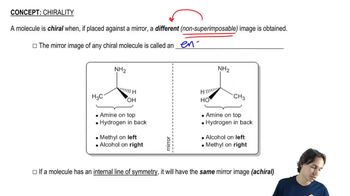
Chirality refers to the geometric property of a molecule that makes it non-superimposable on its mirror image. A chiral molecule typically has at least one carbon atom bonded to four different substituents, resulting in two distinct forms known as enantiomers. Understanding chirality is crucial for determining the optical activity of compounds, as chiral molecules can rotate plane-polarized light.
Recommended video:
Guided course
05:10
What is chirality?

Optical Activity

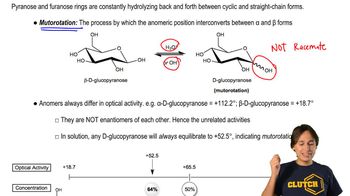
Optical activity is the ability of a chiral substance to rotate the plane of polarized light. This property arises from the asymmetry of chiral molecules, which can exist in two enantiomeric forms that rotate light in opposite directions. The degree of rotation is measured using a polarimeter and is an important characteristic in distinguishing between different enantiomers in organic compounds.
Recommended video:
Guided course
08:17
Mutorotation and Optical Activity

Structural Isomers

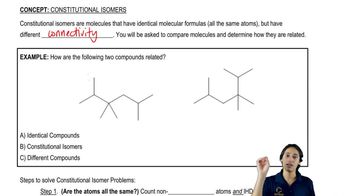
Structural isomers are compounds that have the same molecular formula but differ in the arrangement of atoms. Glucose and fructose are structural isomers, specifically aldose and ketose sugars, respectively. This difference in structure affects their physical and chemical properties, including their chirality and optical activity, making it essential to analyze their configurations when discussing their mirror images.
Recommended video:
Guided course
01:10
What is a constitutional isomer?