Ch. 23 - Carbohydrates and Nucleic Acids
Wade - Organic Chemistry 9th Edition
Wade9th EditionOrganic ChemistryISBN: 9780135213728Not the one you use?Change textbook
Chapter 23, Problem 64

Draw the structure of a four-residue segment of DNA with the following sequence. (3′end) G-T-A-C (5′ end)

Verified step by step guidance
1
Understand the problem: You are tasked with drawing a four-residue segment of DNA with the sequence G-T-A-C, starting from the 3′ end and ending at the 5′ end. DNA is composed of nucleotides, each containing a sugar (deoxyribose), a phosphate group, and a nitrogenous base (Guanine, Thymine, Adenine, Cytosine).
Step 1: Begin by drawing the backbone of the DNA strand. The backbone consists of alternating deoxyribose sugars and phosphate groups. Each sugar is connected to the next via a phosphodiester bond, which links the 3′ hydroxyl group of one sugar to the 5′ phosphate group of the next sugar.
Step 2: Attach the nitrogenous bases to the 1′ carbon of each deoxyribose sugar. For the given sequence (3′ end G-T-A-C 5′ end), attach Guanine (G) to the first sugar, Thymine (T) to the second sugar, Adenine (A) to the third sugar, and Cytosine (C) to the fourth sugar.
Step 3: Ensure the correct orientation of the strand. The 3′ end of the DNA strand should have a free hydroxyl (-OH) group on the 3′ carbon of the first sugar, and the 5′ end should have a free phosphate group attached to the 5′ carbon of the last sugar.
Step 4: Double-check the structure for accuracy. Verify that the phosphodiester bonds are correctly formed, the bases are properly attached to the sugars, and the strand is oriented from 3′ to 5′ as specified in the problem.

Verified video answer for a similar problem:

This video solution was recommended by our tutors as helpful for the problem above.
Was this helpful?

Key Concepts

Here are the essential concepts you must grasp in order to answer the question correctly.

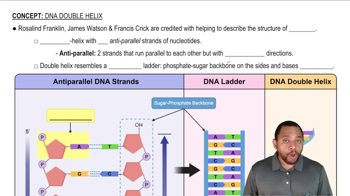
DNA Structure

DNA is a double helix composed of nucleotides, each containing a sugar, a phosphate group, and a nitrogenous base. The sequence of these bases (adenine, thymine, cytosine, and guanine) encodes genetic information. In a DNA strand, the 3' and 5' ends refer to the orientation of the sugar-phosphate backbone, which is crucial for understanding how strands are synthesized and paired.
Recommended video:
3:27
DNA Double Helix Concept 1

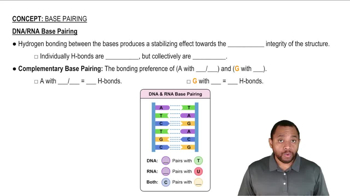
Base Pairing

In DNA, base pairing occurs between specific nitrogenous bases: adenine pairs with thymine (A-T) and cytosine pairs with guanine (C-G). This complementary pairing is essential for the stability of the DNA double helix and for accurate replication and transcription processes. Understanding base pairing is vital for drawing correct DNA sequences.
Recommended video:
2:56
Base Pairing Concept 1

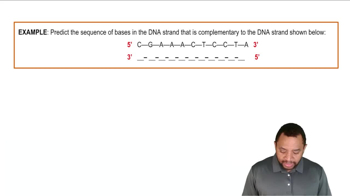
Directionality of DNA Strands

DNA strands have directionality, indicated by the 5' and 3' ends. The 5' end has a phosphate group attached to the fifth carbon of the sugar, while the 3' end has a hydroxyl group on the third carbon. This directionality is important for processes like DNA replication and transcription, as enzymes synthesize new strands in a 5' to 3' direction.
Recommended video:
1:49
DNA Double Helix Example 1