Ch. 6 - Stereoisomerism: Arrangement of Atoms in Space
Mullins - Organic Chemistry: A Learner Centered Approach 1st Edition
Mullins1st EditionOrganic Chemistry: A Learner Centered ApproachISBN: 9780137566471Not the one you use?Change textbook
Chapter 5, Problem 10b

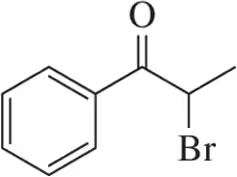
For each of the following molecules, draw one 3-D representation at only the necessary atoms (that is, the ones with four different atoms/groups attached).
(b) Chemical structure of a brominated aromatic compound with an oxygen atom, highlighting necessary atoms for 3-D representation.

Verified step by step guidance
1
Identify the stereocenter in the molecule. A stereocenter is an atom (usually carbon) that is attached to four different groups. In the given molecule, the carbon atom bonded to the chlorine (Cl), a methyl group (CH3), a hydrogen (H), and the carbonyl group (C=O) is the stereocenter.
Understand the 3-D representation of the stereocenter. The stereocenter is represented using wedge and dash bonds to indicate the spatial arrangement of the groups. A wedge bond indicates a group coming out of the plane towards the viewer, while a dash bond indicates a group going behind the plane away from the viewer.
Assign priorities to the four groups attached to the stereocenter based on the Cahn-Ingold-Prelog (CIP) priority rules. The group with the highest atomic number gets the highest priority. In this case: Cl > C=O > CH3 > H.
Position the lowest priority group (hydrogen) on the dash bond (going behind the plane). Arrange the other groups (Cl, CH3, and C=O) around the stereocenter based on their priorities.
Draw the 3-D representation of the stereocenter with the correct spatial arrangement of the groups. Ensure the wedge and dash bonds are used appropriately to depict the stereochemistry of the molecule.

Verified video answer for a similar problem:

This video solution was recommended by our tutors as helpful for the problem above.
Video duration:
1m
Was this helpful?

Key Concepts

Here are the essential concepts you must grasp in order to answer the question correctly.

Chirality

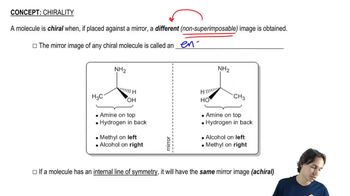
Chirality refers to the geometric property of a molecule that makes it non-superimposable on its mirror image. A chiral molecule typically has a carbon atom bonded to four different substituents, leading to two distinct enantiomers. Understanding chirality is crucial for predicting the behavior of molecules in biological systems, as enantiomers can have different effects.
Recommended video:
Guided course
05:10
What is chirality?

3-D Molecular Representation

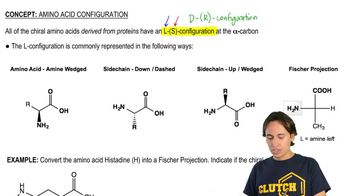
3-D molecular representation is a way to depict the spatial arrangement of atoms in a molecule. This representation is essential for visualizing chirality, as it shows how different groups are oriented in three-dimensional space. Techniques such as wedge-and-dash notation or ball-and-stick models are commonly used to illustrate these spatial relationships.
Recommended video:
Guided course
05:09
Representations of L-Configuration

Functional Groups

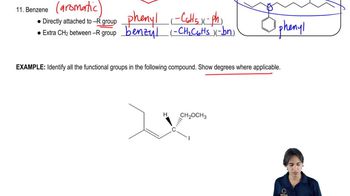
Functional groups are specific groups of atoms within molecules that are responsible for the characteristic chemical reactions of those molecules. In the context of the given molecule, the presence of a chlorine atom and a carbonyl group (C=O) indicates specific reactivity and properties. Identifying functional groups is key to understanding the behavior and classification of organic compounds.
Recommended video:
Guided course
02:36
Identifying Functional Groups