Ch. 10 - Alkynes: Electrophilic Addition and Redox Reactions
Mullins - Organic Chemistry: A Learner Centered Approach 1st Edition
Mullins1st EditionOrganic Chemistry: A Learner Centered ApproachISBN: 9780137566471Not the one you use?Change textbook
Chapter 9, Problem 47a

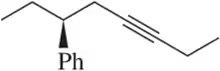
Suggest a method for synthesizing the following alkynes using an alkyne and an alkyl halide. [There are two correct answers for each product.]
(a) Chemical structure of an alkyne with a phenyl group, illustrating synthesis methods for alkynes.

Verified step by step guidance
1
Step 1: Identify the target alkyne structure and determine the two possible fragments that can combine to form the product. The fragments should include an alkyne (nucleophile) and an alkyl halide (electrophile).
Step 2: Recall the reaction mechanism for alkylation of terminal alkynes. Terminal alkynes can be deprotonated using a strong base, such as sodium amide (NaNH₂), to generate a nucleophilic acetylide ion.
Step 3: Choose an appropriate alkyl halide for the reaction. The alkyl halide should be a primary or methyl halide to avoid side reactions like elimination. Secondary or tertiary alkyl halides are not suitable for this reaction.
Step 4: Write the reaction for the first synthesis pathway. Deprotonate the terminal alkyne with NaNH₂ to form the acetylide ion, then react it with the chosen alkyl halide to form the desired alkyne product.
Step 5: Repeat the process for the second synthesis pathway by selecting a different combination of alkyne and alkyl halide fragments that can also form the target alkyne product. Ensure the reaction conditions are suitable for the chosen fragments.

Verified video answer for a similar problem:

This video solution was recommended by our tutors as helpful for the problem above.
Video duration:
4m
Was this helpful?

Key Concepts

Here are the essential concepts you must grasp in order to answer the question correctly.

Alkynes

Alkynes are hydrocarbons that contain at least one carbon-carbon triple bond. They are unsaturated compounds with the general formula CnH2n-2. Understanding their structure and reactivity is crucial for predicting the outcomes of chemical reactions, especially in synthesis. Alkynes can participate in various reactions, including nucleophilic substitutions and eliminations, which are essential for forming new carbon-carbon bonds.
Recommended video:
Guided course
09:11
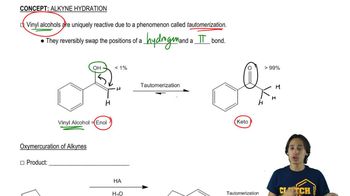
Alkyne Hydration

Nucleophilic Substitution Reactions

Nucleophilic substitution reactions involve the replacement of a leaving group in a molecule with a nucleophile. In the context of synthesizing alkynes, alkyl halides can undergo these reactions with alkynes to form new carbon-carbon bonds. The mechanism can be either SN1 or SN2, depending on the structure of the alkyl halide and the conditions of the reaction. Understanding these mechanisms is vital for predicting the products of the synthesis.
Recommended video:
Guided course
01:47
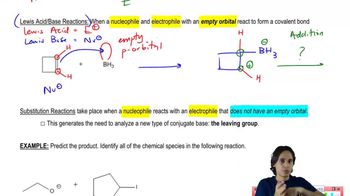
Nucleophiles and Electrophiles can react in Substitution Reactions.

Elimination Reactions

Elimination reactions involve the removal of atoms or groups from a molecule, resulting in the formation of a double or triple bond. In the synthesis of alkynes, elimination reactions can be used to convert dihaloalkanes or alcohols into alkynes. The most common elimination reactions are E1 and E2, which differ in their mechanisms and conditions. Recognizing the conditions that favor elimination over substitution is key to successfully synthesizing the desired alkyne.
Recommended video:
Guided course
00:40
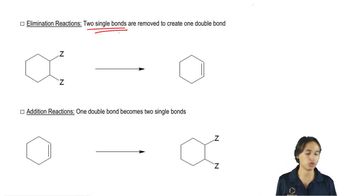
Recognizing Elimination Reactions.