Ch. 9 - Substitution and Elimination Reactions of Alkyl Halides
Bruice - Organic Chemistry 8th Edition
Bruice8th EditionOrganic ChemistryISBN: 9780135213711Not the one you use?Change textbook
Chapter 10, Problem 115b

Draw the products of each of the following SN2/E2 reactions. If the products can exist as stereoisomers, show which stereoisomers are formed.
b. (3R,4R)-3-bromo-4-methylhexane + CH3O

Verified step by step guidance
1
Identify the type of reaction: The problem specifies SN2/E2 reactions. SN2 reactions involve a backside attack by the nucleophile, leading to inversion of configuration at the carbon center. E2 reactions involve elimination, forming a double bond between adjacent carbons.
Analyze the substrate: The substrate is (3R,4R)-3-bromo-4-methylhexane. The bromine atom is attached to the 3rd carbon, and the 4th carbon has a methyl group. The stereochemistry is specified as (3R,4R), so the 3rd carbon is in the R configuration, and the 4th carbon is also in the R configuration.
Consider the nucleophile/base: CH3O⁻ (methoxide ion) is both a strong nucleophile and a strong base. This means it can participate in both SN2 and E2 mechanisms. The reaction conditions will determine which pathway dominates.
Determine the products for each mechanism: For the SN2 reaction, the methoxide ion will attack the 3rd carbon (where the bromine is attached) from the opposite side, displacing the bromine and inverting the configuration at the 3rd carbon. For the E2 reaction, the methoxide ion will abstract a β-hydrogen (from the 2nd or 4th carbon), leading to the formation of a double bond between the 2nd and 3rd carbons or the 3rd and 4th carbons. Consider Zaitsev's rule, which favors the more substituted alkene.
Account for stereoisomers: For the SN2 product, the inversion of configuration at the 3rd carbon will result in a specific stereoisomer. For the E2 product, if a double bond forms between the 3rd and 4th carbons, cis/trans (E/Z) isomerism may occur. Draw all possible stereoisomers for the products and label them clearly.

Verified video answer for a similar problem:

This video solution was recommended by our tutors as helpful for the problem above.
Video duration:
3m
Was this helpful?

Key Concepts

Here are the essential concepts you must grasp in order to answer the question correctly.

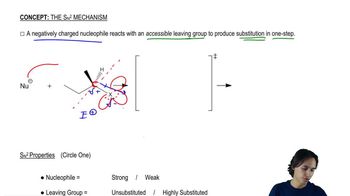
SN2 Reaction Mechanism

The SN2 (substitution nucleophilic bimolecular) reaction involves a nucleophile attacking an electrophile, resulting in the simultaneous displacement of a leaving group. This mechanism is characterized by a single concerted step, where the nucleophile approaches the electrophile from the opposite side of the leaving group, leading to inversion of configuration at the chiral center. Understanding this mechanism is crucial for predicting the stereochemical outcome of reactions.
Recommended video:
Guided course
08:33
Drawing the SN2 Mechanism

E2 Reaction Mechanism

The E2 (elimination bimolecular) reaction is a one-step process where a base abstracts a proton from a β-carbon while a leaving group departs from the α-carbon, resulting in the formation of a double bond. This reaction typically requires a strong base and is stereospecific, often favoring the formation of the more stable alkene. Recognizing the conditions that favor E2 over SN2 is essential for determining the products of the reaction.
Recommended video:
Guided course
09:36
Drawing the E2 Mechanism.

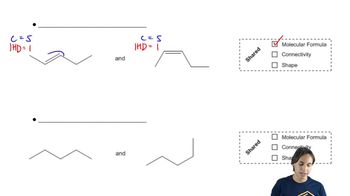
Stereoisomerism

Stereoisomerism refers to the existence of compounds with the same molecular formula and connectivity but different spatial arrangements of atoms. In the context of the given reaction, the formation of stereoisomers can occur due to the chiral centers present in the substrate. Understanding how stereochemistry is affected by the reaction mechanism (SN2 or E2) is vital for accurately depicting the products and their stereoisomers.
Recommended video:
Guided course
01:58
Determining when molecules are stereoisomers.