Join thousands of students who trust us to help them ace their exams!
Multiple Choice
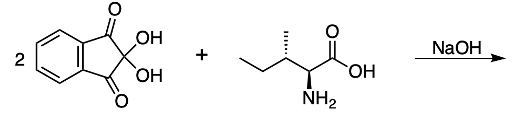
Name the aldehyde formed when isoleucine reacts with ninhydrin.
A
(R)-2-methylbutanal
B
Pentanal
C
(S)-2-methylbutanal
D
(S)-3-methylbutanal
0 Comments
Verified step by step guidance
1
Identify the reactants: The first reactant is ninhydrin, a common reagent used to detect amino acids. The second reactant is isoleucine, an amino acid with a specific stereochemistry at its chiral center.
Understand the reaction: Ninhydrin reacts with amino acids to form an aldehyde, carbon dioxide, and ammonia. This reaction is often used in amino acid analysis.
Determine the structure of the aldehyde: The reaction with ninhydrin typically involves the decarboxylation of the amino acid, leading to the formation of an aldehyde. In this case, the side chain of isoleucine will form the aldehyde.
Consider the stereochemistry: Isoleucine has a chiral center, and the reaction with ninhydrin will retain the stereochemistry of the side chain. Therefore, the aldehyde formed will have the same stereochemistry as the original chiral center in isoleucine.
Name the aldehyde: Based on the structure and stereochemistry, the aldehyde formed is (S)-2-methylbutanal, as the reaction retains the stereochemistry of the original chiral center in isoleucine.


 Verified step by step guidance