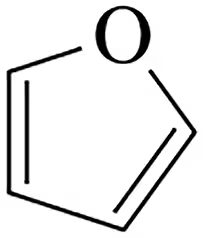
Use a Frost circle diagram to construct the molecular orbital diagram for the molecules shown. Would you expect them to be aromatic or antiaromatic? (b)
Verified step by step guidance
1
Identify the molecule: The structure shown is furan, a five-membered heterocyclic compound with an oxygen atom and two double bonds.
Determine the number of π electrons: Furan has two double bonds, contributing 4 π electrons, and the oxygen atom contributes 2 π electrons from its lone pair, totaling 6 π electrons.
Construct the Frost circle: Draw a circle with the polygon (pentagon for furan) inscribed such that one vertex is at the bottom. The vertices of the polygon represent the energy levels of the molecular orbitals.
Fill the molecular orbitals with electrons: Place the 6 π electrons into the molecular orbitals starting from the lowest energy level, following Hund's rule and the Pauli exclusion principle.
Determine aromaticity: Apply Hückel's rule, which states that a molecule is aromatic if it has (4n + 2) π electrons, where n is a non-negative integer. Since furan has 6 π electrons, it satisfies Hückel's rule (n=1), indicating that it is aromatic.
Verified video answer for a similar problem:
This video solution was recommended by our tutors as helpful for the problem above
Video duration:
2m
Play a video:
0 Comments
Key Concepts
Here are the essential concepts you must grasp in order to answer the question correctly.
Molecular Orbital Theory
Molecular Orbital Theory describes how atomic orbitals combine to form molecular orbitals, which can be occupied by electrons. In this theory, electrons are delocalized over the entire molecule rather than being localized between individual atoms. Understanding this concept is crucial for constructing molecular orbital diagrams, as it helps predict the stability and reactivity of molecules based on their electron configurations.
Aromaticity refers to a property of cyclic, planar molecules with a ring of resonance bonds that leads to enhanced stability. For a molecule to be considered aromatic, it must follow Hückel's rule, which states that it should have 4n + 2 π electrons, where n is a non-negative integer. Aromatic compounds exhibit unique chemical properties, including increased stability and specific reactivity patterns, making this concept essential for analyzing the given molecules.
The Frost Circle Diagram is a graphical method used to determine the molecular orbitals of cyclic compounds, particularly in assessing their aromaticity. By inscribing a polygon in a circle and marking the vertices, one can visualize the energy levels of the molecular orbitals. This diagram helps identify the number of π electrons and their arrangement, which is critical for evaluating whether a molecule is aromatic or antiaromatic based on its electron count and structure.