Ch. 18 - Ketones and Aldehydes
Wade - Organic Chemistry 9th Edition
Wade9th EditionOrganic ChemistryISBN: 9780135213728Not the one you use?Change textbook
Chapter 18, Problem 31a

Like other strong nucleophiles, triphenylphosphine attacks and opens epoxides. The initial product (a betaine) quickly cyclizes to an oxaphosphetane that collapses to an alkene and triphenylphosphine oxide.
(a) Show each step in the reaction of trans-2,3-epoxybutane with triphenylphosphine to give but-2-ene. What is the stereochemistry of the double bond in the product?

Verified step by step guidance
1
Step 1: Recognize the reaction mechanism. This reaction involves the nucleophilic attack of triphenylphosphine (PPh₃) on the epoxide ring of trans-2,3-epoxybutane. The lone pair on the phosphorus atom of PPh₃ makes it a strong nucleophile.
Step 2: Identify the site of nucleophilic attack. The nucleophile (PPh₃) attacks the less sterically hindered carbon of the epoxide ring, leading to the opening of the ring. This forms a betaine intermediate, where the oxygen atom becomes negatively charged, and the phosphorus atom becomes positively charged.
Step 3: Cyclization to form an oxaphosphetane. The negatively charged oxygen atom in the betaine intermediate attacks the positively charged phosphorus atom, resulting in the formation of a four-membered oxaphosphetane ring.
Step 4: Collapse of the oxaphosphetane. The oxaphosphetane undergoes a [2+2] cycloreversion, breaking the P-O bond and forming a double bond between the two carbons. This step produces but-2-ene and triphenylphosphine oxide (PPh₃=O).
Step 5: Determine the stereochemistry of the product. Since the starting material is trans-2,3-epoxybutane, the stereochemistry of the product (but-2-ene) will also be trans. This is due to the stereospecific nature of the reaction, which preserves the trans configuration of the starting material.

Verified video answer for a similar problem:

This video solution was recommended by our tutors as helpful for the problem above.
Video duration:
10m
Was this helpful?

Key Concepts

Here are the essential concepts you must grasp in order to answer the question correctly.

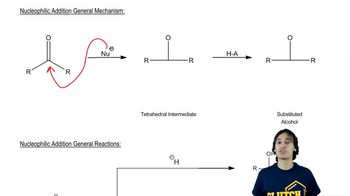
Nucleophilic Attack

Nucleophilic attack is a fundamental reaction mechanism in organic chemistry where a nucleophile, a species with a high electron density, donates an electron pair to an electrophile, forming a new bond. In the context of epoxides, strong nucleophiles like triphenylphosphine can open the three-membered ring, leading to the formation of a more stable product. Understanding this concept is crucial for predicting the outcome of reactions involving epoxides.
Recommended video:
Guided course
08:27
Nucleophilic Addition

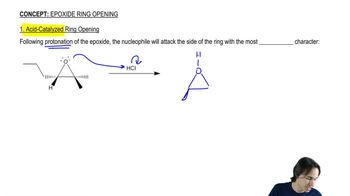
Epoxide Ring Opening

Epoxide ring opening is a specific reaction where the strained three-membered epoxide ring is attacked by a nucleophile, resulting in the formation of a more stable structure. This process can lead to the formation of intermediates such as betaines and oxaphosphetanes, which are key to understanding the reaction pathway. Recognizing the stereochemical implications of this opening is essential for determining the configuration of the final product.
Recommended video:
Guided course
04:34
Acid-Catalyzed Epoxide Ring-Opening

Stereochemistry of Alkenes

Stereochemistry refers to the spatial arrangement of atoms in molecules and is crucial in determining the properties and reactivity of compounds. In the case of alkenes, the configuration around the double bond can be either cis or trans, affecting the physical and chemical behavior of the compound. Analyzing the stereochemistry of the product formed from the reaction of triphenylphosphine with trans-2,3-epoxybutane is vital for understanding the final structure of but-2-ene.
Recommended video:
1:38
Polymer Stereochemistry Concept 1