Ch. 17 - Reactions of Aromatic Compounds
Wade - Organic Chemistry 9th Edition
Wade9th EditionOrganic ChemistryISBN: 9780135213728Not the one you use?Change textbook
Chapter 17, Problem 55d,e

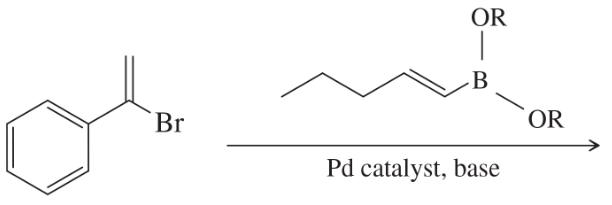
What products would you expect from the following coupling reactions?
(d)
(e)

Verified step by step guidance
1
Step 1: Identify the type of coupling reaction. The first reaction involves a bromobenzene derivative and a boronic ester, which suggests a Suzuki coupling reaction. The second reaction involves a bromonaphthalene derivative and a nitro-substituted styrene, which suggests a Heck coupling reaction.
Step 2: For the Suzuki coupling reaction, the palladium catalyst facilitates the cross-coupling between the aryl bromide and the boronic ester. The base activates the boronic ester, allowing it to react with the aryl bromide. The product will be a new C-C bond formed between the phenyl group and the alkene chain attached to the boron.
Step 3: For the Heck coupling reaction, the palladium catalyst and base facilitate the formation of a C-C bond between the aryl bromide and the alkene. The nitro-substituted styrene will couple with the bromonaphthalene derivative, forming a new C-C bond at the β-position of the alkene relative to the nitro group.
Step 4: Consider regioselectivity and stereochemistry. In the Suzuki reaction, the product will retain the stereochemistry of the alkene in the boronic ester. In the Heck reaction, the product will likely favor the trans configuration of the alkene due to steric and electronic factors.
Step 5: Write the final structures of the products. For the Suzuki reaction, the product will be a phenyl group attached to the alkene chain. For the Heck reaction, the product will be a naphthalene group attached to the β-position of the nitro-substituted styrene alkene.

Verified video answer for a similar problem:

This video solution was recommended by our tutors as helpful for the problem above.
Video duration:
4m
Was this helpful?

Key Concepts

Here are the essential concepts you must grasp in order to answer the question correctly.

Coupling Reactions

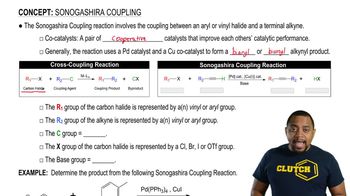
Coupling reactions are organic reactions where two fragments are joined together, typically involving the formation of a new carbon-carbon bond. These reactions are crucial in organic synthesis, particularly in the formation of complex molecules. Common types include Suzuki, Heck, and Sonogashira reactions, each utilizing different reagents and conditions to achieve the desired product.
Recommended video:
Guided course
02:54
Sonogashira Coupling Reaction

Reactivity of Functional Groups

Understanding the reactivity of functional groups is essential in predicting the outcomes of coupling reactions. Different functional groups, such as halides, alcohols, and amines, have distinct reactivity patterns that influence how they participate in reactions. Recognizing these patterns helps in determining which groups can effectively couple and what products will form.
Recommended video:
Guided course
02:36
Identifying Functional Groups

Mechanism of Reactions

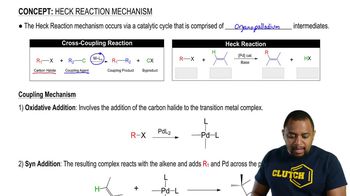
The mechanism of a reaction outlines the step-by-step process by which reactants are converted into products. In coupling reactions, mechanisms often involve the formation of intermediates and the breaking and forming of bonds. A clear understanding of these mechanisms allows chemists to predict reaction outcomes and optimize conditions for desired products.
Recommended video:
Guided course
02:16
Heck Reaction Mechanism