Ch. 21 - Conjugated Systems I: Stability and Addition Reactions
Mullins - Organic Chemistry: A Learner Centered Approach 1st Edition
Mullins1st EditionOrganic Chemistry: A Learner Centered ApproachISBN: 9780137566471Not the one you use?Change textbook
Chapter 20, Problem 46b

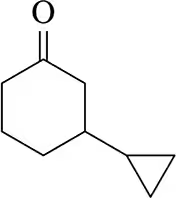
Suggest a reagent and a reactant that could be used to form the following molecules by conjugate addition of a cuprate. There can be multiple possibilities.
(b) Chemical structure of a cyclic compound with a carbonyl group and a side chain, illustrating conjugate addition concepts.

Verified step by step guidance
1
Identify the target molecule as a cyclohexanone derivative with a cyclopropyl group attached at the beta position relative to the carbonyl group.
Recognize that conjugate addition (1,4-addition) involves the addition of a nucleophile to the beta position of an alpha, beta-unsaturated carbonyl compound.
Select an appropriate alpha, beta-unsaturated carbonyl compound as the starting material. In this case, cyclohexenone can be used as it has the necessary unsaturation for conjugate addition.
Choose a suitable cuprate reagent for the conjugate addition. A common choice is a lithium diorganocuprate, such as lithium cyclopropylcuprate (LiCu(C3H5)2), which can deliver the cyclopropyl group to the beta position.
Outline the reaction: The lithium cyclopropylcuprate will add to the beta position of cyclohexenone, resulting in the formation of the desired cyclohexanone derivative with a cyclopropyl group at the beta position.

Verified video answer for a similar problem:

This video solution was recommended by our tutors as helpful for the problem above.
Video duration:
4m
Was this helpful?

Key Concepts

Here are the essential concepts you must grasp in order to answer the question correctly.

Conjugate Addition

Conjugate addition refers to the nucleophilic addition of a reagent to the β-carbon of an α,β-unsaturated carbonyl compound. This reaction typically involves the addition of a nucleophile to the double bond, resulting in the formation of a new carbon-carbon bond. Understanding this mechanism is crucial for predicting the products of reactions involving cuprates and unsaturated carbonyls.
Recommended video:
Guided course
09:23
1,2 vs 1,4 Addition

Cuprates

Cuprates are organocopper reagents, commonly represented as R2CuLi, where R is an organic group. They are powerful nucleophiles used in organic synthesis, particularly for conjugate additions to α,β-unsaturated carbonyl compounds. Their ability to selectively add to the β-position makes them valuable for forming complex molecules in a controlled manner.

Reagent and Reactant Selection

Choosing the appropriate reagent and reactant is essential for successful conjugate addition. The reactant is typically an α,β-unsaturated carbonyl compound, while the reagent is a cuprate that can provide the necessary nucleophile. Understanding the structure and reactivity of both components helps in predicting the outcome of the reaction and the formation of desired products.
Recommended video: