
Ch. 16 - Aromatic Compounds
Wade - Organic Chemistry 9th Edition
Wade9th EditionOrganic ChemistryISBN: 9780135213728Not the one you use?Change textbook
Chapter 16, Problem 42d,e,f

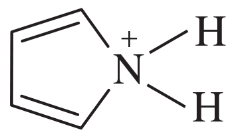
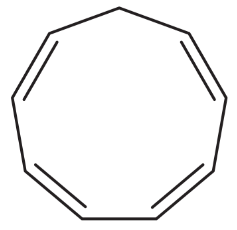
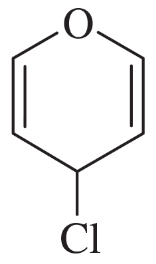
How would you convert the following compounds to aromatic compounds?
(d)
(e)
(f)

Verified step by step guidance
1
Step 1: For compound (d), analyze the structure of pyridinium ion. It already has a conjugated π-system and satisfies Huckel's rule (4n+2 π-electrons, where n=1). No further conversion is needed as it is already aromatic.
Step 2: For compound (e), examine the cyclooctatetraene structure. It is non-aromatic due to its non-planar geometry. To convert it to an aromatic compound, you can oxidize it to form cyclooctatetraenyl dianion, which adopts a planar structure and satisfies Huckel's rule with 10 π-electrons.
Step 3: For compound (f), analyze the structure of the chlorinated oxane ring. It is non-aromatic due to the lack of conjugation. To convert it to an aromatic compound, you can remove the chlorine atom and introduce a double bond to form a fully conjugated system, such as furan.
Step 4: Ensure that each resulting compound satisfies Huckel's rule (4n+2 π-electrons) and adopts a planar geometry, which are the key criteria for aromaticity.
Step 5: Verify the stability and resonance of the resulting aromatic compounds to confirm their aromatic nature.

Verified video answer for a similar problem:

This video solution was recommended by our tutors as helpful for the problem above.
Video duration:
14m
Was this helpful?

Key Concepts

Here are the essential concepts you must grasp in order to answer the question correctly.

Aromaticity

Aromaticity refers to the special stability and reactivity of certain cyclic compounds that contain conjugated pi electron systems. For a compound to be aromatic, it must be cyclic, planar, and follow Hückel's rule, which states that it must have 4n + 2 pi electrons, where n is a non-negative integer. This unique electron configuration allows for delocalization, contributing to the compound's stability.
Recommended video:
Guided course
08:19
Intro to Aromaticity

Electrophilic Aromatic Substitution (EAS)

Electrophilic Aromatic Substitution is a fundamental reaction mechanism in organic chemistry where an electrophile replaces a hydrogen atom on an aromatic ring. This process is crucial for the functionalization of aromatic compounds, allowing for the introduction of various substituents while maintaining the aromatic character of the ring. Common electrophiles include halogens, nitronium ions, and sulfonium ions.
Recommended video:

Nucleophilic Aromatic Substitution (NAS)

Nucleophilic Aromatic Substitution occurs when a nucleophile attacks an aromatic compound, typically one that has electron-withdrawing groups, leading to the displacement of a leaving group. This reaction is less common than EAS and often requires specific conditions, such as the presence of strong nucleophiles or elevated temperatures. It is particularly useful for modifying aromatic compounds that are otherwise resistant to electrophilic attack.
Recommended video:
Guided course
02:10
NAS in the addition-elimination pathway
Related Practice
Textbook Question

The ribonucleosides that make up ribonucleic acid (RNA) are composed of D-ribose (a sugar) and four heterocyclic “bases.” The general structure of a ribonucleoside is shown here.

The four heterocyclic bases are cytosine, uracil, guanine, and adenine. Cytosine and uracil are called pyrimidine bases because their structures resemble pyrimidine. Guanine and adenine are called purine bases because their structures resemble purine.

c. Do any of these bases have easily formed tautomers that are aromatic? (Consider moving a proton from nitrogen to a carbonyl group to form a phenolic derivative.)

Textbook Question

Biphenyl has the following structure.

c. The heat of hydrogenation for biphenyl is about 418 kJ/mol (100 kcal/mol). Calculate the resonance energy of biphenyl.

d. Compare the resonance energy of biphenyl with that of naphthalene and with that of two benzene rings. Explain the difference in the resonance energies of naphthalene and biphenyl.

1
views
Textbook Question

The ribonucleosides that make up ribonucleic acid (RNA) are composed of D-ribose (a sugar) and four heterocyclic “bases.” The general structure of a ribonucleoside is shown here.

The four heterocyclic bases are cytosine, uracil, guanine, and adenine. Cytosine and uracil are called pyrimidine bases because their structures resemble pyrimidine. Guanine and adenine are called purine bases because their structures resemble purine.

b. Predict which nitrogen atoms are basic.

9
views
Textbook Question

The ribonucleosides that make up ribonucleic acid (RNA) are composed of D-ribose (a sugar) and four heterocyclic “bases.” The general structure of a ribonucleoside is shown here.

The four heterocyclic bases are cytosine, uracil, guanine, and adenine. Cytosine and uracil are called pyrimidine bases because their structures resemble pyrimidine. Guanine and adenine are called purine bases because their structures resemble purine.

a. Determine which rings of these bases are aromatic.

2
views
Textbook Question

Anions of hydrocarbons are rare, and dianions of hydrocarbons are extremely rare. The following hydrocarbon reacts with two equivalents of butyllithium to form a dianion of formula [C8H6]2–. Propose a structure for this dianion, and suggest why it forms so readily.

3
views
Textbook Question

How would you convert the following compounds to aromatic compounds?

(a)

(b)

(c)

1
views