Ch. 17 - Reactions of Aromatic Compounds
Wade - Organic Chemistry 9th Edition
Wade9th EditionOrganic ChemistryISBN: 9780135213728Not the one you use?Change textbook
Chapter 17, Problem 32d,e

Predict the major products of the following reactions.
(d) p-xylene + Na (liquid NH3, CH3CH2OH)
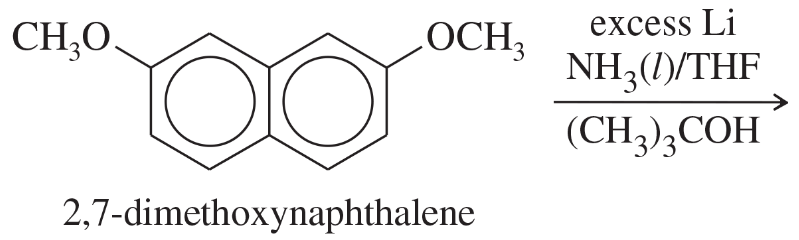
(e)

Verified step by step guidance
1
Step 1: Analyze the reaction conditions for part (d). The reaction involves p-xylene with sodium in liquid ammonia and ethanol. This is a Birch reduction, which selectively reduces aromatic rings to form 1,4-cyclohexadienes. Identify the positions on the aromatic ring where reduction will occur, considering the electron-donating methyl groups.
Step 2: For part (d), predict the major product by determining which positions on the aromatic ring will remain unaffected and which will be reduced. The methyl groups are electron-donating, so the reduction will occur at positions opposite to the methyl groups.
Step 3: Analyze the reaction conditions for part (e). The reaction involves 2,7-dimethoxynaphthalene with excess lithium in liquid ammonia and THF, followed by tert-butanol. This is also a Birch reduction, but applied to a polycyclic aromatic compound. The methoxy groups are electron-donating, influencing the reduction pattern.
Step 4: For part (e), predict the major product by determining which positions on the naphthalene ring system will be reduced. The methoxy groups stabilize the aromaticity of the adjacent rings, so reduction will occur at positions farthest from the methoxy groups.
Step 5: Summarize the major products for both reactions. For part (d), the product is a 1,4-cyclohexadiene derivative of p-xylene. For part (e), the product is a partially reduced naphthalene derivative with the reduction occurring at positions farthest from the methoxy groups.

Verified video answer for a similar problem:

This video solution was recommended by our tutors as helpful for the problem above.
Video duration:
2m
Was this helpful?

Key Concepts

Here are the essential concepts you must grasp in order to answer the question correctly.

Birch Reduction

The Birch reduction is a chemical reaction that involves the reduction of aromatic compounds using alkali metals in liquid ammonia, often in the presence of an alcohol. This reaction typically results in the formation of 1,4-cyclohexadienes from aromatic rings, effectively breaking the aromaticity and introducing new functional groups. The reaction is particularly useful for modifying polycyclic aromatic compounds, such as naphthalene derivatives.

Aromatic Compounds

Aromatic compounds are a class of cyclic compounds characterized by their stable ring structure and delocalized π-electrons, which confer unique chemical properties. They follow Huckel's rule, having (4n + 2) π-electrons, which contributes to their stability and reactivity. Understanding the nature of aromaticity is crucial for predicting the outcomes of reactions involving these compounds, such as electrophilic substitutions or reductions.

Nucleophilic Substitution

Nucleophilic substitution is a fundamental reaction mechanism in organic chemistry where a nucleophile replaces a leaving group in a molecule. In the context of the Birch reduction, the alkali metal acts as a nucleophile, attacking the aromatic system and facilitating the reduction process. This concept is essential for understanding how the structure of the starting material influences the products formed during the reaction.