Ch. 23 - Carbohydrates and Nucleic Acids
Wade - Organic Chemistry 9th Edition
Wade9th EditionOrganic ChemistryISBN: 9780135213728Not the one you use?Change textbook
Chapter 23, Problem 49

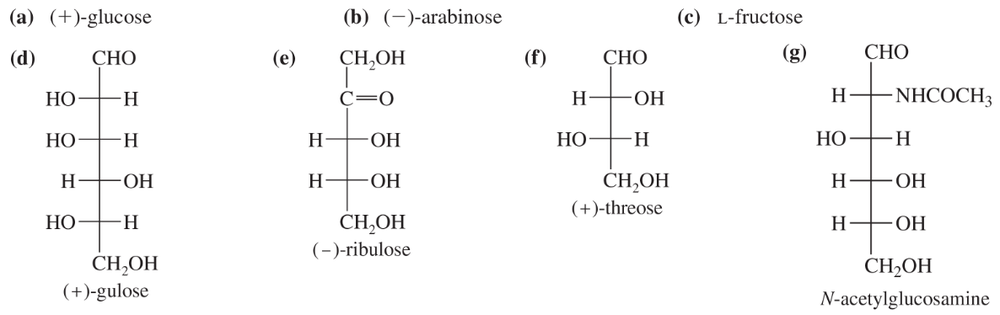
Classify the following monosaccharides. (Examples: D-aldohexose, L-ketotetrose.)

Verified step by step guidance
1
Step 1: Analyze the structure of each monosaccharide provided in the image. Determine whether the molecule contains an aldehyde group (CHO) or a ketone group (C=O). Monosaccharides with an aldehyde group are classified as aldoses, while those with a ketone group are classified as ketoses.
Step 2: Count the number of carbon atoms in the backbone of each monosaccharide. Monosaccharides are classified based on the number of carbons: triose (3 carbons), tetrose (4 carbons), pentose (5 carbons), hexose (6 carbons), etc.
Step 3: Determine the stereochemistry of each monosaccharide. Look at the configuration of the chiral centers and identify whether the molecule belongs to the D-series or L-series. This is based on the orientation of the hydroxyl group (-OH) on the penultimate carbon (second-to-last carbon). If the hydroxyl group is on the right in a Fischer projection, it is a D-sugar; if on the left, it is an L-sugar.
Step 4: Combine the information from Steps 1, 2, and 3 to classify each monosaccharide. For example, a molecule with an aldehyde group, six carbons, and belonging to the D-series would be classified as a D-aldohexose.
Step 5: For special cases like N-acetylglucosamine (g), note any functional group modifications (e.g., the presence of an acetyl group attached to the amino group). This modification does not change the classification as an aldose or ketose but adds specificity to the name.

Verified video answer for a similar problem:

This video solution was recommended by our tutors as helpful for the problem above.
Video duration:
6m
Was this helpful?

Key Concepts

Here are the essential concepts you must grasp in order to answer the question correctly.

Monosaccharide Classification

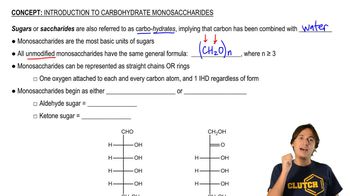
Monosaccharides can be classified based on the number of carbon atoms they contain and the functional groups present. They are categorized as aldoses, which contain an aldehyde group, or ketoses, which contain a ketone group. Additionally, they can be classified by their stereochemistry, such as D- or L- configurations, which refer to the orientation of the hydroxyl group on the chiral carbon farthest from the carbonyl group.
Recommended video:
Guided course
12:01
Monosaccharide

D and L Configuration

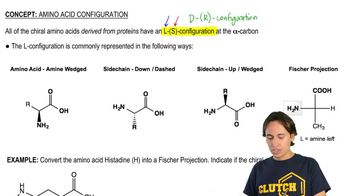
The D and L notation in carbohydrates indicates the configuration of the chiral carbon furthest from the carbonyl group. D-sugars have the hydroxyl group on the right side in a Fischer projection, while L-sugars have it on the left. This classification is crucial for understanding the stereochemistry of sugars and their biological roles, as D-sugars are more common in nature.
Recommended video:
Guided course
05:09
Representations of L-Configuration

Optical Activity

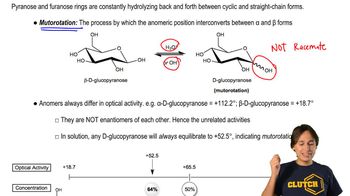
Optical activity refers to the ability of a compound to rotate plane-polarized light, a property exhibited by chiral molecules. Monosaccharides can be optically active, and their specific rotation can be positive or negative, indicating whether they rotate light to the right (dextrorotatory) or to the left (levorotatory). This property is essential for distinguishing between different sugars, such as (+)-glucose and (-)-arabinose.
Recommended video:
Guided course
08:17
Mutorotation and Optical Activity
Related Practice
Textbook Question

Without referring to the chapter, draw the chair conformations of

(d) N-acetylglucosamine, glucose with the C2 oxygen atom replaced by an acetylated amino group.

3
views

Textbook Question

Use Figure 23-3 (the D family of aldoses) to name the following aldoses.

(a) the C2 epimer of D-arabinose

(b) the C3 epimer of D-mannose

(c) the C3 epimer of D-threose

1
views
Textbook Question

Predict the products obtained when d-galactose reacts with each reagent.

(b) NaOH, H2O

2
views
Textbook Question

Without referring to the chapter, draw the chair conformations of

(c) β-D-galactopyranose (the C4 epimer of glucose).

1
views
Textbook Question

(a) Give the products expected when (+)-glyceraldehyde reacts with HCN.

(b) What is the relationship between the products? How might they be separated?

(c) Are the products optically active? Explain.

Textbook Question

The relative configurations of the stereoisomers of tartaric acid were established by the following syntheses:

(1) D-(+)-glyceraldehyde HCN\(\xrightarrow{HCN}\) diastereomers A and B (separated)

(2) Hydrolysis of A and B using aqueous Ba(OH)2 gave C and D, respectively.

(3) HNO3 oxidation of C and D gave (-)-tartaric acid and meso-tartaric acid, respectively.

(a) You know the absolute configuration of D-(+)-glyceraldehyde. Use Fischer projections to show the absolute configurations of products A, B, C, and D.

(b) Show the absolute configurations of the three stereoisomers of tartaric acid: (+)-tartaric acid, (-)-tartaric acid, and meso-tartaric acid.

1
views