Ch. 2 - General Chemistry Translated: Finding the Electrons
Mullins - Organic Chemistry: A Learner Centered Approach 1st Edition
Mullins1st EditionOrganic Chemistry: A Learner Centered ApproachISBN: 9780137566471Not the one you use?Change textbook
Chapter 1, Problem 62u

Draw the Lewis structure for the following molecular formulas.
(u) NH4+

Verified step by step guidance
1
Step 1: Begin by identifying the total number of valence electrons in the molecule. Nitrogen (N) has 5 valence electrons, and each hydrogen (H) has 1 valence electron. Since the molecule has a positive charge (NH⁺₄), subtract 1 electron from the total count.
Step 2: Place the nitrogen atom at the center of the structure because it is less electronegative than hydrogen. Arrange the four hydrogen atoms around the nitrogen atom symmetrically.
Step 3: Draw single bonds between the nitrogen atom and each hydrogen atom. Each single bond represents 2 electrons, so account for these electrons in the total count.
Step 4: Check if the nitrogen atom has a complete octet (8 electrons) and if all hydrogen atoms have a complete duet (2 electrons). Since the molecule is positively charged, ensure the structure reflects the loss of one electron.
Step 5: Verify the formal charges on all atoms. The nitrogen atom should have a formal charge of +1, and the hydrogens should have a formal charge of 0. Ensure the overall charge of the molecule is +1, consistent with NH⁺₄.

Verified video answer for a similar problem:

This video solution was recommended by our tutors as helpful for the problem above.
Was this helpful?

Key Concepts

Here are the essential concepts you must grasp in order to answer the question correctly.

Lewis Structures

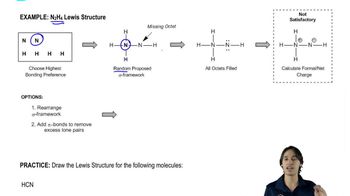
Lewis structures are diagrams that represent the bonding between atoms in a molecule and the lone pairs of electrons that may exist. They use dots to represent electrons and lines to represent bonds between atoms. Understanding how to draw Lewis structures is essential for visualizing molecular geometry and predicting the behavior of molecules in chemical reactions.
Recommended video:
Guided course
04:12
Drawing the Lewis Structure for N2H4.

Valence Electrons

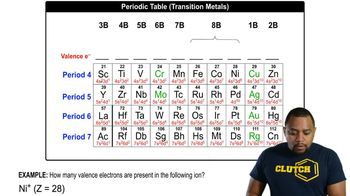
Valence electrons are the outermost electrons of an atom and are crucial for determining how atoms bond with each other. The number of valence electrons influences the molecule's reactivity and stability. For example, nitrogen has five valence electrons, which play a key role in forming bonds in compounds like NH₄⁺.
Recommended video:
Guided course
03:40
Valence Electrons of Transition Metals

Formal Charge

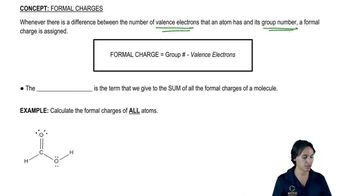
Formal charge is a concept used to determine the distribution of electrons in a molecule and assess the stability of its Lewis structure. It is calculated by comparing the number of valence electrons in an isolated atom to the number of electrons assigned to it in the Lewis structure. A structure with the lowest formal charges on atoms is generally more stable, guiding the correct representation of molecules like NH₄⁺.
Recommended video:
Guided course
01:34
Calculating formal and net charge.