Ch. 17 - Reactions of Aromatic Compounds
Wade - Organic Chemistry 9th Edition
Wade9th EditionOrganic ChemistryISBN: 9780135213728Not the one you use?Change textbook
Chapter 17, Problem 36

Predict the major products when the following compounds are irradiated by light and treated with (1) 1 equivalent of Br2 and (2) excess Br2.
(a) isopropylbenzene
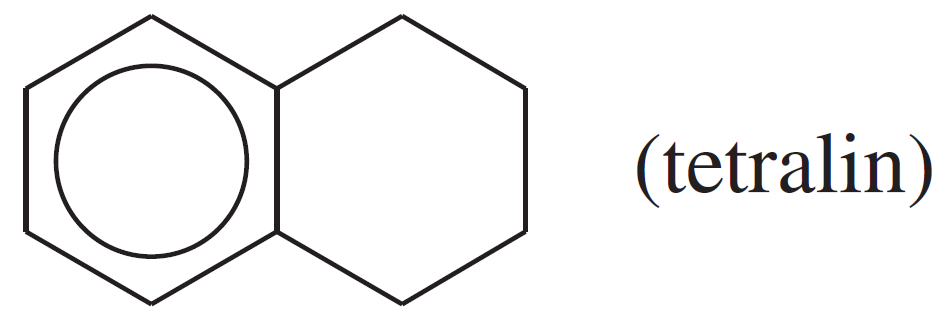
(b)

Verified step by step guidance
1
Step 1: Analyze the reaction conditions. The problem specifies irradiation by light and treatment with bromine (Br2). This indicates a radical bromination reaction, which typically occurs at the most stable hydrogen-bearing carbon in the molecule.
Step 2: For (a) isopropylbenzene, identify the most stable radical that can form. The benzylic position (the carbon directly attached to the benzene ring) is the most reactive due to resonance stabilization of the benzylic radical. Bromination will occur at this position.
Step 3: For (b), the provided structure is indane (a bicyclic compound with a benzene ring fused to a cyclopentane ring). Identify the most stable radical that can form. The benzylic position (the CH2 group attached to the benzene ring) is the most reactive due to resonance stabilization of the benzylic radical. Bromination will occur at this position.
Step 4: When treated with 1 equivalent of Br2, only one bromine atom will be added to the most reactive position (benzylic position) in both compounds. This results in monosubstitution.
Step 5: When treated with excess Br2, further bromination can occur. For isopropylbenzene, additional bromination may occur at the other hydrogens on the benzylic carbon. For indane, additional bromination may occur at the remaining hydrogens on the benzylic CH2 group. The extent of bromination depends on the amount of Br2 and reaction conditions.

Verified video answer for a similar problem:

This video solution was recommended by our tutors as helpful for the problem above.
Video duration:
9m
Was this helpful?

Key Concepts

Here are the essential concepts you must grasp in order to answer the question correctly.

Free Radical Halogenation

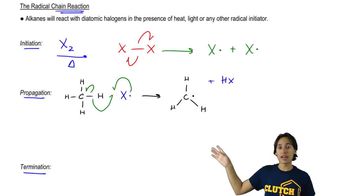
Free radical halogenation is a reaction mechanism where halogens (like Br2) react with alkanes or alkyl groups in the presence of light or heat, leading to the formation of free radicals. This process involves three steps: initiation, propagation, and termination. The light energy generates halogen radicals, which then abstract hydrogen atoms from the organic substrate, resulting in the formation of alkyl halides.
Recommended video:
Guided course
12:11
Radical Chain Reaction Mechanism.

Selectivity in Halogenation

Selectivity in halogenation refers to the preference of halogen radicals to abstract hydrogen atoms from certain positions in a molecule, influenced by factors like sterics and stability of the resulting radicals. For example, in isopropylbenzene, the more stable tertiary radical is favored over secondary or primary radicals, leading to specific products. This selectivity is crucial for predicting the major products of the reaction.
Recommended video:
Guided course
03:45
Halogenation Mechanism

Excess Halogen Effects

When excess halogen is used in a reaction, it can lead to further halogenation of the product formed. In the case of isopropylbenzene treated with excess Br2, not only will the initial halogenation occur, but the resulting alkyl halide can undergo additional halogenation, potentially leading to polyhalogenated products. Understanding this concept is essential for predicting the final products in reactions involving halogens.
Recommended video:
Guided course
04:21
How to calculate enantiomeric excess.