

Ch. 28 - Pericyclic Reactions
Bruice - Organic Chemistry 8th Edition
Bruice8th EditionOrganic ChemistryISBN: 9780135213711Not the one you use?Change textbook
Chapter 25, Problem 1

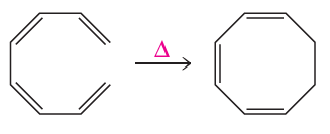
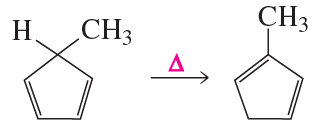
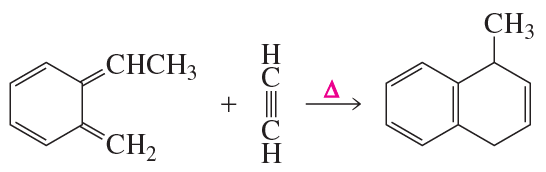
Examine the following pericyclic reactions. For each reaction, tell whether it is an electrocyclic reaction, a cycloaddition reaction, or a sigmatropic rearrangement.
a. Illustration of pericyclic reactions with structures and arrows indicating reaction types.
b. Chemical structure transformation illustrating a pericyclic reaction with reactants on the left and product on the right.
c. Chemical structures illustrating a pericyclic reaction with reactants and products, including a heat symbol.
d. Chemical structures illustrating a pericyclic reaction with reactants and products labeled, including a heat symbol.

Verified step by step guidance
1
Step 1: Understand the three types of pericyclic reactions. An electrocyclic reaction involves the opening or closing of a conjugated π-system to form a new σ-bond or break an existing one. A cycloaddition reaction involves the formation of a cyclic product by the combination of two π-systems. A sigmatropic rearrangement involves the migration of a σ-bond across a π-system, with the overall connectivity of the molecule remaining unchanged.
Step 2: Analyze reaction (a). Look for changes in the π-system and determine if a new σ-bond is formed (electrocyclic), if two π-systems combine to form a ring (cycloaddition), or if a σ-bond migrates across a π-system (sigmatropic rearrangement).
Step 3: Analyze reaction (b). Use the same criteria as in Step 2 to classify the reaction. Pay attention to the movement of electrons and the formation or breaking of bonds.
Step 4: Analyze reaction (c). Again, determine whether the reaction involves the opening/closing of a π-system (electrocyclic), the combination of two π-systems (cycloaddition), or the migration of a σ-bond (sigmatropic rearrangement).
Step 5: Analyze reaction (d). Follow the same process as in the previous steps to classify the reaction based on the changes in bonding and electron movement.

Verified video answer for a similar problem:

This video solution was recommended by our tutors as helpful for the problem above.
Was this helpful?

Key Concepts

Here are the essential concepts you must grasp in order to answer the question correctly.

Pericyclic Reactions

Pericyclic reactions are a class of organic reactions that occur through a concerted mechanism, involving a cyclic transition state. These reactions typically involve the rearrangement of electrons in a way that conserves orbital symmetry, and they can be classified into three main types: electrocyclic reactions, cycloadditions, and sigmatropic rearrangements.
Recommended video:
Guided course
07:37
Properties and Types of Pericyclic Reactions

Electrocyclic Reactions

Electrocyclic reactions involve the conversion of a conjugated system into a cyclic structure through the breaking and forming of sigma bonds. These reactions are characterized by the movement of electrons in a way that can be influenced by heat or light, and they follow specific rules based on the number of π electrons involved, as described by the Woodward-Hoffmann rules.
Recommended video:
Guided course
08:11
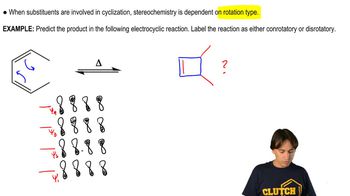
Predicting Electrocyclic Products

Cycloaddition Reactions

Cycloaddition reactions are a type of pericyclic reaction where two or more unsaturated molecules or fragments combine to form a cyclic product. These reactions can be classified as [2+2] or [4+2] cycloadditions, depending on the number of π bonds involved. The stereochemistry and regioselectivity of these reactions are crucial for determining the structure of the final product.
Recommended video:
Guided course
08:29
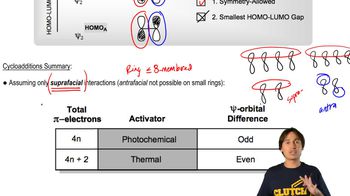
Cycloadditions Summary Chart