Ch. 1 - Remembering General Chemistry: Electronic Structure and Bonding (Part 1)
Bruice - Organic Chemistry 8th Edition
Bruice8th EditionOrganic ChemistryISBN: 9780135213711Not the one you use?Change textbook
Chapter 1, Problem 6a,b

Look at the relative positions of each pair of atoms listed here in the periodic table. How many core electrons does each have? How many valence electrons does each have?
a. carbon and silicon
b. oxygen and sulfur

Verified step by step guidance
1
Step 1: Recall the periodic table structure. Elements are arranged in periods (rows) and groups (columns). Core electrons are the inner electrons that are not involved in bonding, while valence electrons are the outermost electrons in the highest energy level (shell).
Step 2: For carbon (C) and silicon (Si), identify their positions in the periodic table. Carbon is in Group 14 (4A) and Period 2, while silicon is in Group 14 (4A) and Period 3. Both belong to the same group, meaning they have the same number of valence electrons.
Step 3: Determine the electron configuration for carbon (atomic number 6): 1s² 2s² 2p². The core electrons are in the 1s orbital (2 electrons), and the valence electrons are in the 2s and 2p orbitals (4 electrons). For silicon (atomic number 14): 1s² 2s² 2p⁶ 3s² 3p². The core electrons are in the 1s, 2s, and 2p orbitals (10 electrons), and the valence electrons are in the 3s and 3p orbitals (4 electrons).
Step 4: For oxygen (O) and sulfur (S), identify their positions in the periodic table. Oxygen is in Group 16 (6A) and Period 2, while sulfur is in Group 16 (6A) and Period 3. Both belong to the same group, meaning they have the same number of valence electrons.
Step 5: Determine the electron configuration for oxygen (atomic number 8): 1s² 2s² 2p⁴. The core electrons are in the 1s orbital (2 electrons), and the valence electrons are in the 2s and 2p orbitals (6 electrons). For sulfur (atomic number 16): 1s² 2s² 2p⁶ 3s² 3p⁴. The core electrons are in the 1s, 2s, and 2p orbitals (10 electrons), and the valence electrons are in the 3s and 3p orbitals (6 electrons).

Verified video answer for a similar problem:

This video solution was recommended by our tutors as helpful for the problem above.
Video duration:
4m
Was this helpful?

Key Concepts

Here are the essential concepts you must grasp in order to answer the question correctly.

Core Electrons

Core electrons are the electrons that are located in the inner shells of an atom, which are not involved in chemical bonding. They are typically found in the electron shells closest to the nucleus and are shielded from the effects of external electric fields. For example, in carbon (atomic number 6), there are 2 core electrons in the first shell, while silicon (atomic number 14) has 10 core electrons in its inner shells.
Recommended video:
Guided course
03:54
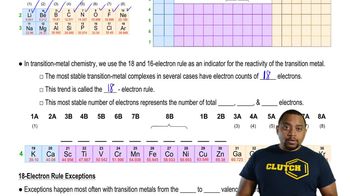
The 18 and 16 Electron Rule

Valence Electrons

Valence electrons are the electrons in the outermost shell of an atom and are crucial for determining how an atom interacts and bonds with other atoms. These electrons are involved in chemical reactions and bonding, influencing the atom's reactivity. For instance, carbon has 4 valence electrons in its outer shell, while silicon has 4 as well, despite having more core electrons.
Recommended video:
Guided course
03:40
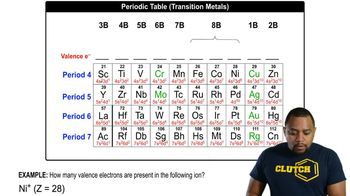
Valence Electrons of Transition Metals

Periodic Table Trends

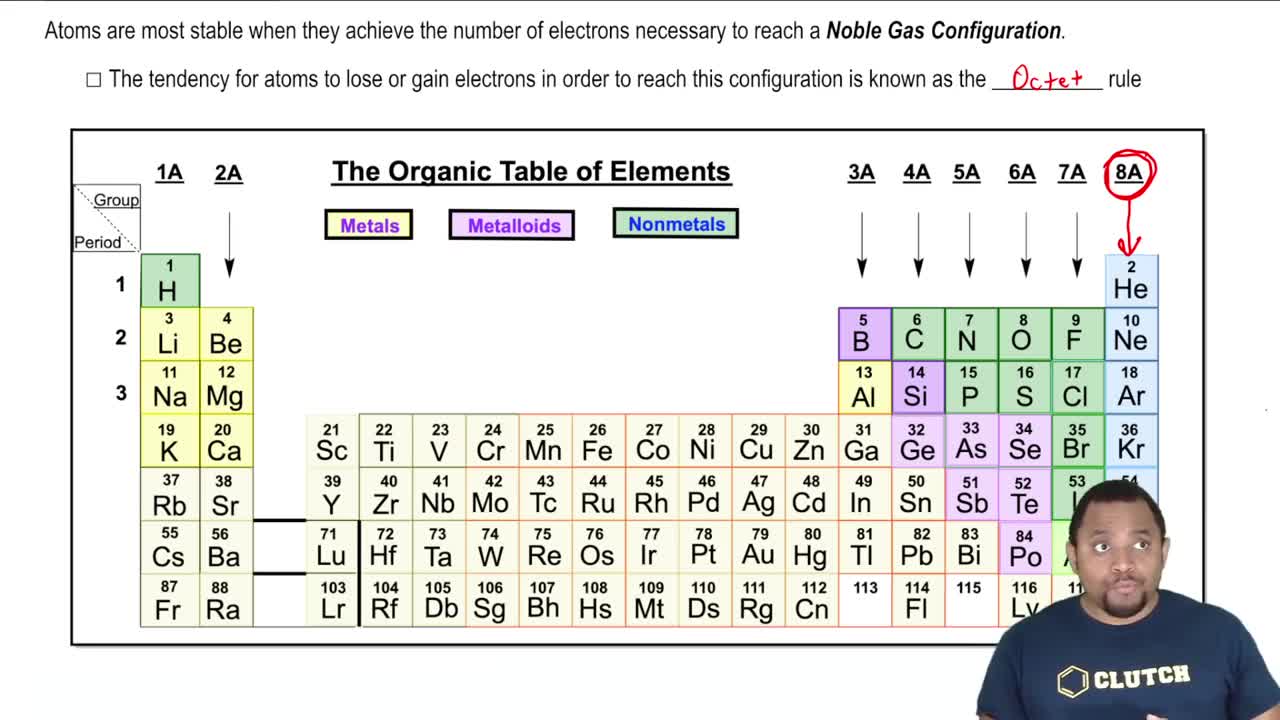
The periodic table organizes elements based on their atomic number and electron configuration, revealing trends in properties such as electronegativity, ionization energy, and the number of valence and core electrons. Elements in the same group (column) typically have similar valence electron configurations, which affects their chemical behavior. For example, oxygen and sulfur are in the same group and have 6 and 6 valence electrons, respectively, but differ in core electrons due to their positions in the table.
Recommended video:
Guided course
02:24
The most important parts of the periodic table for organic chemistry