
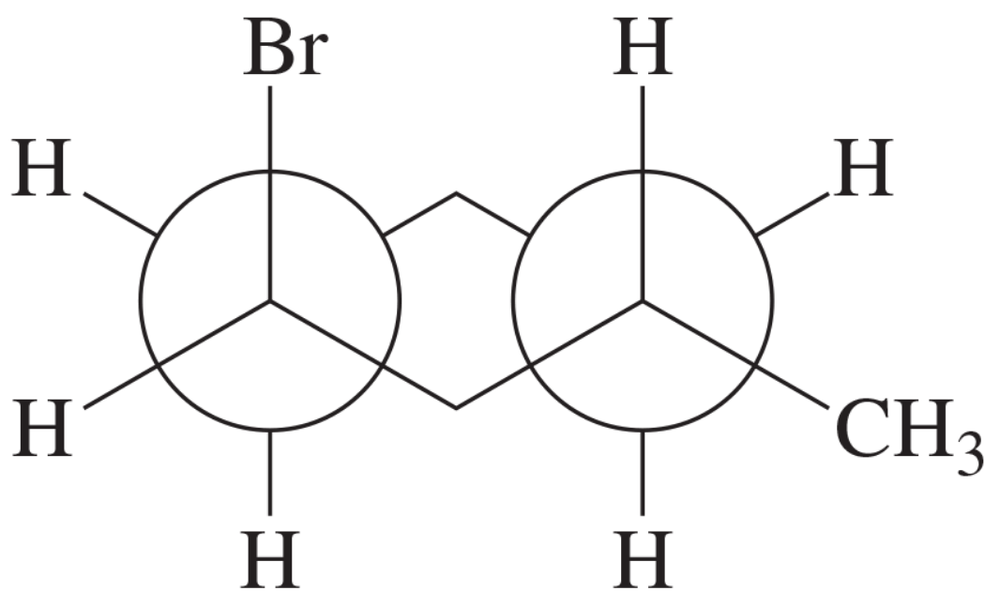

This is a Newman projection of a substituted cyclohexane. a. Draw the equivalent chair form.
Verified step by step guidance
1
Identify the substituents and their positions in the Newman projection. Note the axial and equatorial positions relative to the cyclohexane ring.
Understand the basic structure of a cyclohexane chair conformation, which alternates between axial and equatorial positions for substituents.
Translate the substituents from the Newman projection to the chair conformation. Ensure that substituents that are axial in the Newman projection remain axial in the chair form, and similarly for equatorial substituents.
Draw the cyclohexane ring in the chair conformation, which resembles a 'zig-zag' pattern. Place the substituents at the correct carbon atoms, maintaining their axial or equatorial orientation.
Double-check the stability of the chair conformation. If necessary, perform a ring flip to see if a more stable conformation can be achieved, where larger substituents are in the equatorial position to minimize steric strain.
Verified video answer for a similar problem:
This video solution was recommended by our tutors as helpful for the problem above
Video duration:
2m
Play a video:
0 Comments
Key Concepts
Here are the essential concepts you must grasp in order to answer the question correctly.
Newman Projection
A Newman projection is a method used in organic chemistry to visualize the conformation of a molecule from a specific angle, typically along a carbon-carbon bond axis. It helps in understanding the spatial arrangement of substituents and their steric interactions, which is crucial for analyzing conformational stability.
Cyclohexane can adopt several conformations, with the chair form being the most stable due to minimized steric strain and torsional strain. Understanding these conformations is essential for converting a Newman projection into a chair form, as it involves recognizing the spatial arrangement of substituents in three-dimensional space.
Substituted cyclohexanes have additional groups attached to the cyclohexane ring, affecting its conformational preferences. The position of these substituents (axial or equatorial) in the chair conformation influences the molecule's stability and reactivity, making it important to accurately depict these in the equivalent chair form.