Ch. 15 - Conjugated Systems, Orbital Symmetry, and Ultraviolet Spectroscopy
Wade - Organic Chemistry 9th Edition
Wade9th EditionOrganic ChemistryISBN: 9780135213728Not the one you use?Change textbook
Chapter 15, Problem 4

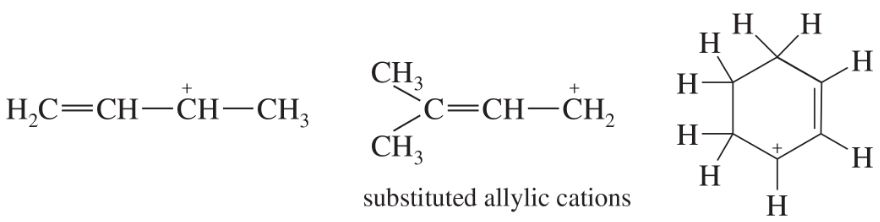
Draw another resonance form for each of the substituted allylic cations shown in the preceding figure, showing how the positive charge is shared by another carbon atom. In each case, state whether your second resonance form is a more important or less important resonance contributor than the first structure. (Which structure places the positive charge on the more-substituted carbon atom?)

Verified step by step guidance
1
Identify the allylic cation structure. An allylic cation is a positively charged species where the positive charge is located on a carbon atom adjacent to a double bond.
Draw the initial resonance structure of the allylic cation. This involves showing the positive charge on the carbon atom that is directly adjacent to the double bond.
To draw another resonance form, move the electrons from the double bond towards the positively charged carbon atom. This will shift the positive charge to the other carbon atom that was part of the double bond.
Evaluate the stability of the new resonance form. The resonance form where the positive charge is on the more substituted carbon atom is generally more stable due to hyperconjugation and inductive effects.
Compare the importance of the resonance forms. The resonance form with the positive charge on the more substituted carbon atom is typically a more important contributor to the resonance hybrid because it is more stable.

Verified video answer for a similar problem:

This video solution was recommended by our tutors as helpful for the problem above.
Video duration:
5m
Was this helpful?

Key Concepts

Here are the essential concepts you must grasp in order to answer the question correctly.

Resonance Structures

Resonance structures are different Lewis structures for a molecule that depict the same arrangement of atoms but differ in the distribution of electrons. They are used to represent delocalized electrons within certain molecules where the bonding cannot be expressed by a single Lewis structure. Resonance structures help in understanding the stability and reactivity of the molecule.
Recommended video:
Guided course
03:04
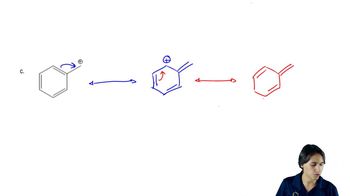
Drawing Resonance Structures

Allylic Cations

Allylic cations are positively charged ions where the positive charge is located on a carbon atom adjacent to a carbon-carbon double bond. These cations are stabilized by resonance, as the positive charge can be delocalized over the π system of the double bond, allowing for multiple resonance structures. This delocalization increases the stability of the cation.
Recommended video:
0:52
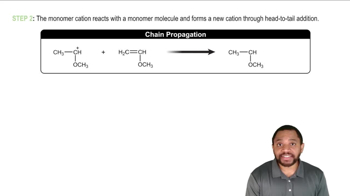
Cationic Polymerization Concept 3

Substituted Carbon Atoms

In organic chemistry, a substituted carbon atom is one that is bonded to one or more substituent groups, which can affect the stability of a molecule. In the context of resonance, placing a positive charge on a more-substituted carbon atom often results in a more stable resonance structure due to hyperconjugation and inductive effects, which help to delocalize the positive charge more effectively.
Recommended video:
Guided course
01:44
The difference between atomic numbers and atomic mass.