Ch. 24 - Amino Acids, Peptides, and Proteins
Wade - Organic Chemistry 9th Edition
Wade9th EditionOrganic ChemistryISBN: 9780135213728Not the one you use?Change textbook
Chapter 24, Problem 8

Draw the electrophoretic separation of Trp, Cys, and His at pH 6.0.

Verified step by step guidance
1
Understand the concept of electrophoresis: Electrophoresis is a technique used to separate molecules based on their charge and size. Amino acids like Trp (Tryptophan), Cys (Cysteine), and His (Histidine) have different charges depending on the pH of the solution due to their ionizable groups.
Determine the ionization state of each amino acid at pH 6.0: At pH 6.0, the amino acids will have specific charges based on the pKa values of their functional groups. For example, Histidine has an imidazole side chain with a pKa around 6.0, making it partially protonated and positively charged. Cysteine has a thiol group with a pKa around 8.3, which will be neutral at pH 6.0. Tryptophan has a non-ionizable side chain and will be neutral at this pH.
Predict the movement of each amino acid in an electrophoretic field: In electrophoresis, positively charged molecules move toward the cathode (negative electrode), negatively charged molecules move toward the anode (positive electrode), and neutral molecules remain stationary. Based on their charges at pH 6.0, His will move toward the cathode, while Trp and Cys will remain stationary.
Draw the electrophoretic separation: Represent the electrophoretic setup with a gel or medium, and indicate the starting positions of Trp, Cys, and His. Show the movement of His toward the cathode, while Trp and Cys remain stationary. Label the electrodes and the amino acids clearly.
Explain the reasoning behind the separation: Highlight how the pH affects the ionization state of the amino acids and their movement in the electrophoretic field. Emphasize the importance of understanding pKa values and the relationship between charge and pH in predicting electrophoretic behavior.

Verified video answer for a similar problem:

This video solution was recommended by our tutors as helpful for the problem above.
Video duration:
7m
Was this helpful?

Key Concepts

Here are the essential concepts you must grasp in order to answer the question correctly.

Isoelectric Point (pI)

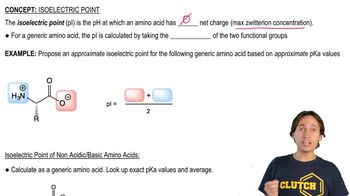
The isoelectric point (pI) is the pH at which a molecule, such as an amino acid, carries no net electrical charge. For amino acids, this is crucial in determining their behavior in electrophoresis, as they will migrate towards the electrode of opposite charge when the pH is below or above their pI. Understanding the pI helps predict the migration direction and speed of Trp, Cys, and His at a specific pH.
Recommended video:
Guided course
03:19
Definition of Isoelectric Point

Amino Acid Structure and Properties

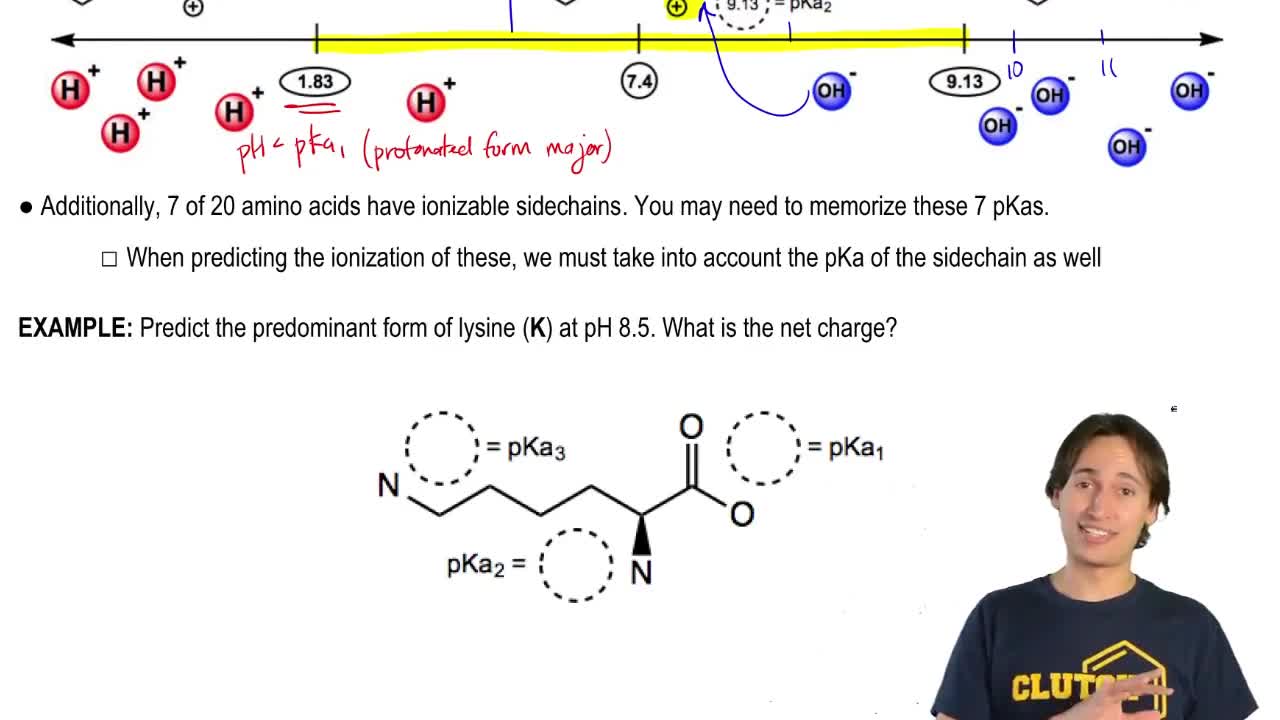
Amino acids have distinct side chains (R groups) that influence their charge and solubility at different pH levels. Tryptophan (Trp) is non-polar, cysteine (Cys) contains a thiol group that can be deprotonated, and histidine (His) has an imidazole side chain that can be positively charged at lower pH. Recognizing these properties is essential for predicting their behavior during electrophoresis at pH 6.0.
Recommended video:
Guided course
04:10
The 7 Ionizable Amino Acids

Electrophoresis

Electrophoresis is a technique used to separate charged molecules in a gel or solution based on their size and charge. When an electric field is applied, molecules migrate towards the electrode of opposite charge. The rate of migration depends on the net charge of the molecules, which is influenced by the pH of the environment, making it vital to understand how Trp, Cys, and His will behave at pH 6.0.