
Textbook Question
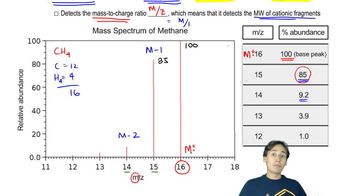
Predict the masses and the structures of the most abundant fragments observed in the mass spectra of the following compounds.
(c) 4-methylpentan-2-ol
1
views

 Verified step by step guidance
 01:25
01:25
 08:06
08:06 06:47
06:47Predict the masses and the structures of the most abundant fragments observed in the mass spectra of the following compounds.
(c) 4-methylpentan-2-ol
Predict the masses and the structures of the most abundant fragments observed in the mass spectra of the following compounds.
(b) 3-methylhex-2-ene
A common lab experiment is the dehydration of cyclohexanol to cyclohexene.
(a) Explain how you could tell from the IR spectrum whether your product was pure cyclohexene, pure cyclohexanol, or a mixture of cyclohexene and cyclohexanol. Give approximate frequencies for distinctive peaks.
(b) Explain why mass spectrometry might not be a good way to distinguish cyclohexene from cyclohexanol.
Convert the following infrared wavelengths to cm-1. (a) 6.24 𝜇m, typical for an aromatic C=C (b) 3.38 𝜇m, typical for a saturated C-H bond (c) 5.85 𝜇m, typical for a ketone carbonyl
Predict the characteristic infrared absorptions of the functional groups in the following molecules.
(d) pent-1-yne
(e) diethylamine
(f) pentanoic acid
Four infrared spectra are shown, corresponding to four of the following compounds. For each spectrum, determine the structure and explain how the peaks in the spectrum correspond to the structure you have chosen.
<IMAGE>