Ch.8 - Reactions of Alkenes
Wade - Organic Chemistry 9th Edition
Wade9th EditionOrganic ChemistryISBN: 9780135213728Not the one you use?Change textbook
Chapter 8, Problem 52c

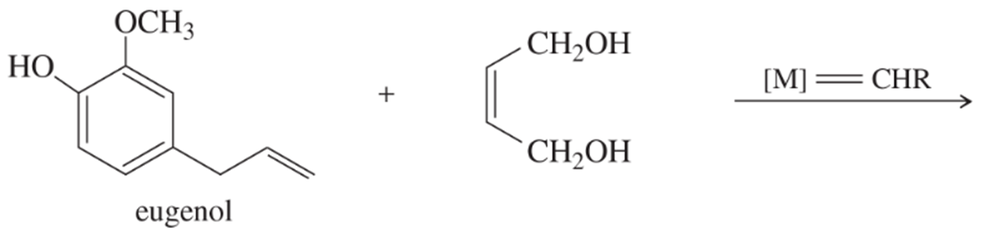
Show what products you would expect from the following metathesis reactions, using the Schrock or Grubbs catalysts.
(c)

Verified step by step guidance
1
Step 1: Identify the reactants involved in the metathesis reaction. The first reactant is eugenol, which contains a terminal alkene group. The second reactant is a diol with a terminal alkene group. The catalyst used is either a Schrock or Grubbs catalyst, which facilitates the metathesis reaction.
Step 2: Understand the mechanism of olefin metathesis. The reaction involves the exchange of alkene fragments between the two reactants, leading to the formation of new carbon-carbon double bonds. The catalyst forms a metallacyclobutane intermediate, which rearranges to produce the products.
Step 3: Predict the products of the reaction. The terminal alkene groups from both reactants will interact, resulting in the formation of two new alkenes. One product will likely be a symmetrical or unsymmetrical alkene formed by the combination of the two reactants' alkene fragments.
Step 4: Consider the functional groups present in the reactants. Eugenol has a phenolic hydroxyl group and a methoxy group, while the diol has two hydroxyl groups. These functional groups remain intact during the metathesis reaction, as the reaction specifically targets the alkene groups.
Step 5: Draw the expected products. The new alkenes formed will reflect the exchange of alkene fragments between the reactants. Ensure that the connectivity of the carbon atoms and the functional groups is preserved in the products.

Verified video answer for a similar problem:

This video solution was recommended by our tutors as helpful for the problem above.
Video duration:
6m
Was this helpful?

Key Concepts

Here are the essential concepts you must grasp in order to answer the question correctly.

Metathesis Reactions

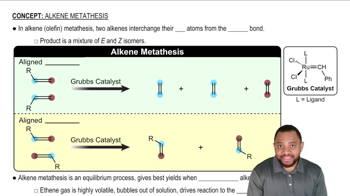
Metathesis reactions involve the exchange of parts between two molecules, typically alkenes, resulting in the formation of new alkenes. This reaction is facilitated by catalysts, such as the Schrock or Grubbs catalysts, which stabilize the transition state and lower the activation energy. In the context of the provided question, eugenol and a diol reactant undergo metathesis to yield new products through the reorganization of their double bonds.
Recommended video:
2:09
Alkene Metathesis Concept 1

Schrock and Grubbs Catalysts

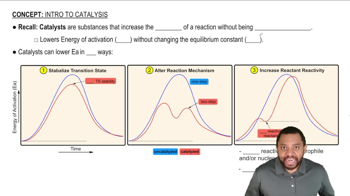
Schrock and Grubbs catalysts are types of transition metal complexes used to promote metathesis reactions. Schrock catalysts are typically based on molybdenum or tungsten, while Grubbs catalysts are based on ruthenium. These catalysts facilitate the breaking and forming of carbon-carbon double bonds, allowing for efficient and selective reactions, which are crucial for synthesizing complex organic molecules.
Recommended video:
2:10
Introduction to Catalysis Concept 1

Product Prediction in Organic Reactions

Predicting the products of organic reactions, such as metathesis, requires understanding the structure of the reactants and the mechanism of the reaction. In this case, the reaction between eugenol and the diol involves the formation of new alkenes through the exchange of alkyl groups. Analyzing the molecular structure and functional groups present helps in determining the likely products and their configurations.
Recommended video:
Guided course
05:44
Predicting Electrocyclic Products