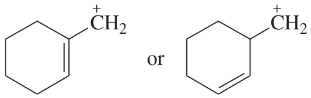
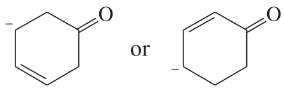
For each pair of ions, determine which ion is more stable. Use resonance forms to explain your answers. (e) (f)
Verified step by step guidance
1
Identify the ions in each pair: In set (e), we have two carbocations, and in set (f), we have two enolate ions.
For set (e), analyze the resonance stabilization: The carbocation adjacent to the double bond can be stabilized by resonance. Draw the resonance structures for each ion to see which one has more resonance forms.
For set (e), compare the resonance forms: The ion with more resonance forms is more stable because the positive charge is delocalized over a larger area, reducing the energy of the system.
For set (f), analyze the resonance stabilization: The enolate ion can be stabilized by resonance between the oxygen and the carbon atoms. Draw the resonance structures for each ion to see which one has more resonance forms.
For set (f), compare the resonance forms: The ion with more resonance forms is more stable because the negative charge is delocalized over a larger area, reducing the energy of the system.
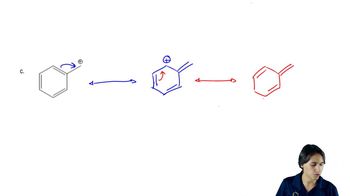
Verified video answer for a similar problem:
This video solution was recommended by our tutors as helpful for the problem above
Video duration:
6m
Play a video:
0 Comments
Key Concepts
Here are the essential concepts you must grasp in order to answer the question correctly.
Resonance
Resonance is a concept in organic chemistry that describes the delocalization of electrons in molecules. It occurs when a molecule can be represented by two or more valid Lewis structures, known as resonance forms. These forms contribute to the overall hybrid structure, which is more stable than any individual resonance form. Understanding resonance is crucial for predicting the stability of ions and molecules, as it allows for the distribution of charge and electron density.
The stability of ions is influenced by several factors, including charge distribution, electronegativity, and resonance. Generally, ions that can delocalize their charge through resonance are more stable than those that cannot. In the context of the question, comparing the stability of the two ions involves analyzing how effectively each ion can distribute its positive charge through resonance structures, which ultimately affects their reactivity and stability.
Electrophilicity refers to the tendency of a species to accept electrons, making it a key factor in determining the reactivity of ions. In the case of positively charged ions, a more stable ion is typically less electrophilic because its positive charge is better stabilized through resonance. Understanding electrophilicity helps in predicting how these ions will interact with nucleophiles and other reactive species in organic reactions.