Ch. 14 - NMR Spectroscopy
Bruice - Organic Chemistry 8th Edition
Bruice8th EditionOrganic ChemistryISBN: 9780135213711Not the one you use?Change textbook
Chapter 15, Problem 46

What does cross peak X in Figure 14.34 tell you?
<IMAGE>

Verified step by step guidance
1
Identify the type of spectroscopy being used in Figure 14.34. Cross peaks are typically observed in 2D NMR spectroscopy, such as COSY (Correlation Spectroscopy) or NOESY (Nuclear Overhauser Effect Spectroscopy). Determine which type of 2D NMR is being referenced.
Understand the significance of a cross peak in the specific 2D NMR technique. For example, in COSY, a cross peak indicates scalar (through-bond) coupling between two protons, while in NOESY, it indicates spatial (through-space) proximity between two nuclei.
Locate cross peak X in the spectrum and identify the chemical shifts of the two nuclei it connects. These chemical shifts correspond to the positions of the nuclei in the 1D NMR spectra along the axes of the 2D plot.
Interpret the relationship between the nuclei based on the type of 2D NMR. For instance, if it is a COSY spectrum, cross peak X suggests that the two protons are coupled, likely indicating they are on adjacent carbons. If it is a NOESY spectrum, cross peak X suggests that the two nuclei are close in space, even if they are not directly bonded.
Use the information from cross peak X to deduce structural or spatial relationships in the molecule. Combine this with other data from the spectrum to refine your understanding of the molecular structure or conformation.

Verified video answer for a similar problem:

This video solution was recommended by our tutors as helpful for the problem above.
Video duration:
3m
Was this helpful?

Key Concepts

Here are the essential concepts you must grasp in order to answer the question correctly.

Cross Peaks in NMR Spectroscopy

Cross peaks in NMR (Nuclear Magnetic Resonance) spectroscopy, particularly in 2D NMR experiments, indicate correlations between different nuclei in a molecule. They arise when two nuclei are coupled, meaning they influence each other's magnetic environments. Analyzing these peaks helps in determining the connectivity and spatial arrangement of atoms within a molecule.
Recommended video:
Guided course
10:06
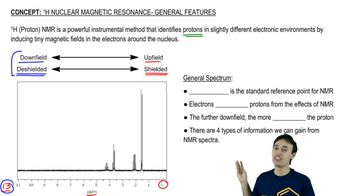
General NMR Features

Chemical Shift

Chemical shift refers to the resonant frequency of a nucleus relative to a standard in a magnetic field, which is influenced by the electronic environment surrounding the nucleus. In NMR, different chemical environments lead to different shifts, allowing chemists to infer structural information about the molecule. Understanding chemical shifts is crucial for interpreting the data presented in NMR spectra.
Recommended video:
Guided course
11:44
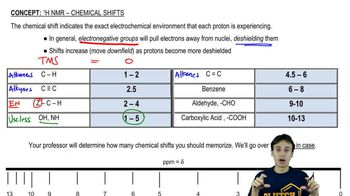
1H NMR Chemical Shifts

Molecular Connectivity

Molecular connectivity describes how atoms within a molecule are linked together, which is essential for understanding its structure and reactivity. In the context of NMR, connectivity information can be deduced from the patterns of peaks observed in the spectrum, including cross peaks. This information is vital for elucidating the three-dimensional arrangement of atoms in complex organic compounds.
Recommended video:
Guided course
08:41
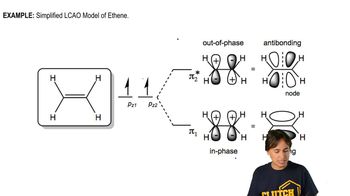
Review of Molecular Orbitals