Ch.8 - Reactions of Alkenes
Wade - Organic Chemistry 9th Edition
Wade9th EditionOrganic ChemistryISBN: 9780135213728Not the one you use?Change textbook
Chapter 8, Problem 7

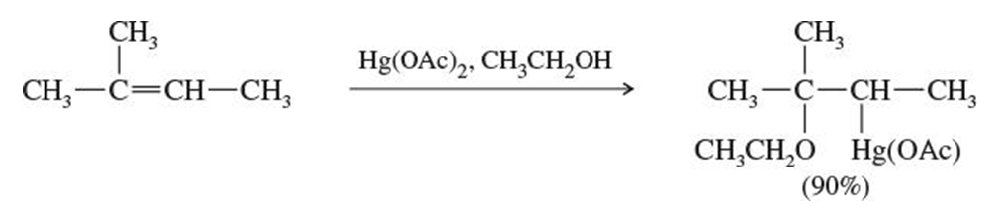
a. Propose a mechanism for the following reaction.

b. Give the structure of the product that results when this intermediate is reduced by sodium borohydride.

Verified step by step guidance
1
Step 1: Analyze the reaction conditions. The reaction involves an alkene (CH3C(CH3)=CHCH3) undergoing oxymercuration in the presence of mercuric acetate (Hg(OAc)2) and ethanol (CH3CH2OH). This is a typical oxymercuration reaction where the alkene reacts with Hg(OAc)2 to form a mercurinium ion intermediate.
Step 2: Propose the mechanism for the formation of the intermediate. The alkene reacts with Hg(OAc)2, leading to the formation of a cyclic mercurinium ion. The positive charge is stabilized by the mercury atom. Ethanol (CH3CH2OH) then acts as a nucleophile, attacking the more substituted carbon of the mercurinium ion, leading to the opening of the ring and forming the intermediate (CH3)2C(CH3CH2O)CH(Hg(OAc))CH3.
Step 3: Explain regioselectivity. The nucleophilic attack by ethanol occurs at the more substituted carbon of the mercurinium ion due to Markovnikov's rule, which states that the nucleophile will add to the carbon with more alkyl substituents.
Step 4: Describe the reduction step. When the intermediate is treated with sodium borohydride (NaBH4), the Hg(OAc) group is replaced by a hydrogen atom. This reduction step leads to the formation of the final product, which is an alcohol with the ethoxy group attached to the more substituted carbon.
Step 5: Consider stereochemistry. The reaction produces a racemic mixture (both enantiomers) because the attack by ethanol on the mercurinium ion can occur from either side of the planar intermediate, leading to two stereoisomers.

Verified video answer for a similar problem:

This video solution was recommended by our tutors as helpful for the problem above.
Video duration:
8m
Was this helpful?

Key Concepts

Here are the essential concepts you must grasp in order to answer the question correctly.

Oxymercuration-Demercuration

Oxymercuration-demercuration is a two-step reaction used to convert alkenes into alcohols. In the first step, an alkene reacts with mercuric acetate (Hg(OAc)2) in the presence of water or alcohol, leading to the formation of a mercurinium ion intermediate. This intermediate is then attacked by a nucleophile, resulting in the formation of an alcohol. The second step involves the reduction of the mercurial intermediate, typically using sodium borohydride (NaBH4), to yield the final alcohol product.
Recommended video:
Guided course
05:
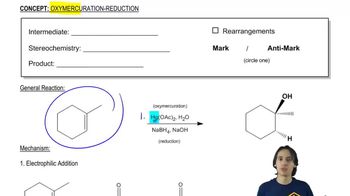
General properties of oxymercuration-reduction.

Mechanism of Oxymercuration

The mechanism of oxymercuration involves the electrophilic addition of the mercuric ion to the double bond of the alkene, forming a cyclic mercurinium ion. This intermediate is stabilized by the positive charge on the mercury, allowing for nucleophilic attack by water or an alcohol at the more substituted carbon. This regioselectivity leads to Markovnikov addition, where the nucleophile adds to the more substituted carbon, resulting in a product with a hydroxyl group and a mercuric acetate group.
Recommended video:
Guided course
09:01
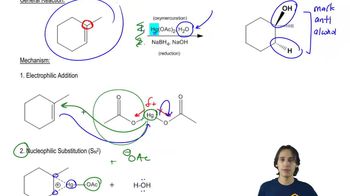
Acid-catalyzed oxymercuration-reduction mechanism

Sodium Borohydride Reduction

Sodium borohydride (NaBH4) is a common reducing agent used in organic chemistry to convert carbonyl compounds and certain organometallic intermediates into alcohols. In the context of oxymercuration, NaBH4 reduces the mercurial intermediate formed during the reaction, replacing the mercury group with a hydrogen atom. This reduction is crucial for obtaining the final alcohol product, which retains the stereochemistry of the original alkene, leading to the formation of enantiomers if the starting material is chiral.
Recommended video:
Guided course
07:12
Reductive Amination