Ch.8 - Reactions of Alkenes
Wade - Organic Chemistry 9th Edition
Wade9th EditionOrganic ChemistryISBN: 9780135213728Not the one you use?Change textbook
Chapter 8, Problem 9a,b

Show how you would accomplish the following synthetic conversions.
a. but-1-ene → 2-methoxybutane
b. 1-iodo-2-methylcyclopentane → 1-methylcyclopentanol

Verified step by step guidance
1
Step 1: For the conversion of but-1-ene to 2-methoxybutane, begin by recognizing that this transformation involves the addition of a methoxy group (-OCH₃) to the second carbon of the butene chain. This suggests the use of an electrophilic addition reaction. First, perform an acid-catalyzed hydration of but-1-ene using water and an acid catalyst (e.g., H₂SO₄) to form 2-butanol. This step follows Markovnikov's rule, where the hydroxyl group (-OH) adds to the more substituted carbon.
Step 2: Convert the 2-butanol intermediate into 2-methoxybutane. This can be achieved by reacting 2-butanol with a strong acid (e.g., H₂SO₄) to form the corresponding carbocation intermediate, followed by nucleophilic substitution using methanol (CH₃OH). Methanol acts as the nucleophile, replacing the hydroxyl group with a methoxy group (-OCH₃).
Step 3: For the conversion of 1-iodo-2-methylcyclopentane to 1-methylcyclopentanol, recognize that this involves replacing the iodine atom with a hydroxyl group (-OH). This suggests a nucleophilic substitution reaction. Use aqueous silver nitrate (AgNO₃) to promote the substitution of the iodine atom with a hydroxyl group, forming 1-methylcyclopentanol.
Step 4: Ensure stereochemistry is considered in both reactions. For the but-1-ene conversion, the addition of the methoxy group follows Markovnikov's rule, favoring the more substituted carbon. For the cyclopentane conversion, the substitution reaction typically proceeds via an SN1 mechanism, forming a carbocation intermediate before the hydroxyl group attaches.
Step 5: Verify the final products by analyzing their structures. For 2-methoxybutane, confirm the methoxy group is attached to the second carbon of the butane chain. For 1-methylcyclopentanol, ensure the hydroxyl group is attached to the same carbon where iodine was originally located, maintaining the cyclopentane ring structure.

Verified video answer for a similar problem:

This video solution was recommended by our tutors as helpful for the problem above.
Video duration:
9m
Was this helpful?

Key Concepts

Here are the essential concepts you must grasp in order to answer the question correctly.

Alkene Reactions

Alkenes are hydrocarbons that contain at least one carbon-carbon double bond. They undergo various reactions, including electrophilic addition and substitution. In the conversion of but-1-ene to 2-methoxybutane, an alkene undergoes an addition reaction with methanol in the presence of an acid catalyst, resulting in the formation of an ether.
Recommended video:
2:09
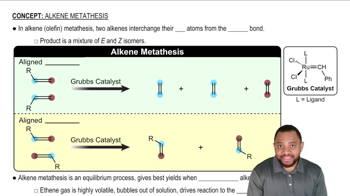
Alkene Metathesis Concept 1

Nucleophilic Substitution

Nucleophilic substitution is a fundamental reaction in organic chemistry where a nucleophile replaces a leaving group in a molecule. In the conversion of 1-iodo-2-methylcyclopentane to 1-methylcyclopentanol, the iodide ion acts as a leaving group, and a nucleophile, such as water or an alcohol, attacks the carbon atom, leading to the formation of an alcohol.
Recommended video:
Guided course
01:47
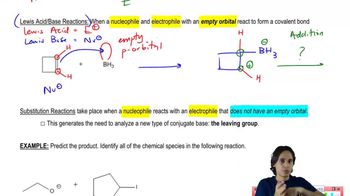
Nucleophiles and Electrophiles can react in Substitution Reactions.

Stereochemistry

Stereochemistry involves the study of the spatial arrangement of atoms in molecules and how this affects their chemical behavior. In synthetic conversions, understanding stereochemistry is crucial, especially when dealing with chiral centers, as the formation of specific stereoisomers can influence the properties and reactivity of the final product, such as in the case of 1-methylcyclopentanol.
Recommended video:
1:38
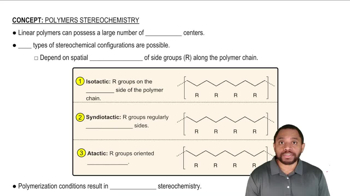
Polymer Stereochemistry Concept 1