
Ch.9 - Alkynes
Wade - Organic Chemistry 9th Edition
Wade9th EditionOrganic ChemistryISBN: 9780135213728Not the one you use?Change textbook
Chapter 9, Problem 40

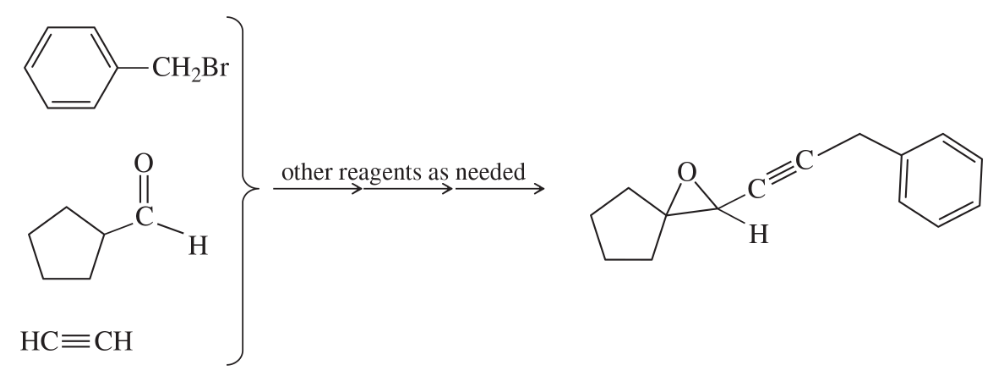
Show how you would convert the following starting materials into the target compound. You may use any additional reagents you need.

Verified step by step guidance
1
Step 1: Begin by converting the benzyl bromide (C6H5CH2Br) into a benzyl acetylide (C6H5CH2C≡C) through a nucleophilic substitution reaction. Use sodium acetylide (NaC≡CH) as the reagent to replace the bromine atom with the acetylide group.
Step 2: Prepare the cyclopentanone for nucleophilic attack by generating its enolate ion. Use a strong base such as sodium hydride (NaH) or lithium diisopropylamide (LDA) to deprotonate the alpha hydrogen of cyclopentanone, forming the enolate ion.
Step 3: Perform an aldol addition reaction between the enolate ion of cyclopentanone and the benzyl acetylide (C6H5CH2C≡C). This step will form a new carbon-carbon bond between the alpha carbon of cyclopentanone and the terminal carbon of the acetylide group.
Step 4: Ensure the product from the aldol addition reaction undergoes proper protonation to stabilize the intermediate. Use a mild acid like ammonium chloride (NH4Cl) or dilute HCl to protonate the oxygen atom and complete the reaction.
Step 5: Confirm the final product matches the target compound, which includes a cyclopentanone structure bonded to a benzyl acetylide group via an alpha carbon. Verify the stereochemistry and connectivity of the molecule.

Verified video answer for a similar problem:

This video solution was recommended by our tutors as helpful for the problem above.
Video duration:
8m
Was this helpful?

Key Concepts

Here are the essential concepts you must grasp in order to answer the question correctly.

Reaction Mechanisms

Understanding reaction mechanisms is crucial in organic chemistry as it describes the step-by-step process by which reactants are converted into products. This includes identifying intermediates, transition states, and the types of bonds formed or broken during the reaction. A clear grasp of mechanisms helps predict the outcome of reactions and the conditions required for successful transformations.
Recommended video:
Guided course
02:16
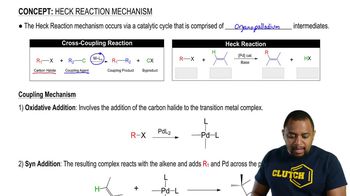
Heck Reaction Mechanism

Functional Groups

Functional groups are specific groups of atoms within molecules that are responsible for the characteristic chemical reactions of those molecules. Recognizing functional groups in the starting materials and target compound is essential for determining the appropriate reagents and reaction conditions needed for conversion. This knowledge allows chemists to manipulate organic compounds effectively.
Recommended video:
Guided course
02:36
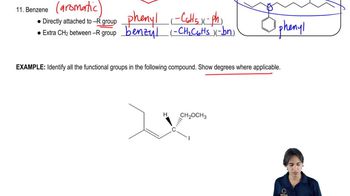
Identifying Functional Groups

Reagents and Conditions

The choice of reagents and reaction conditions is vital in organic synthesis, as they dictate the course and efficiency of the reaction. Different reagents can facilitate various types of reactions, such as oxidation, reduction, or substitution. Understanding how to select and apply the right reagents and conditions is key to successfully converting starting materials into the desired target compound.
Recommended video:
Related Practice
Textbook Question

When treated with hydrogen and a platinum catalyst, an unknown compound X absorbs 5 equivalents of hydrogen to give n-butylcyclohexane. Treatment of X with an excess of ozone, followed by dimethyl sulfide and water, gives the following products:

Propose a structure for the unknown compound X. Is there any uncertainty in your structure?

2
views
Textbook Question

The following functional-group interchange is a useful synthesis of aldehydes.

(c) Explain why a nucleophilic reagent such as ethoxide adds to an alkyne more easily than it adds to an alkene.

7
views
Textbook Question

The following functional-group interchange is a useful synthesis of aldehydes.

(a) What reagents were used in this chapter for this transformation? Give an example to illustrate this method.

(b) This functional-group interchange can also be accomplished using the following sequence.

Propose mechanisms for these steps.

3
views
Textbook Question

Show how you would synthesize the following compounds, starting with acetylene and any compounds containing no more than four carbon atoms.

g. pentanal, CH3CH2CH2CH2CHO

h. pentan-2-one, CH3–CO–CH2CH2CH3

i. (±) 3,4-dibromohexane

1
views
Textbook Question

When compound Z is treated with ozone, followed by dimethyl sulfide and washing with water, the products are formic acid, 3-oxobutanoic acid, and hexanal.

Propose a structure for compound Z. What uncertainty is there in the structure you have proposed?

Textbook Question

Using any necessary inorganic reagents, show how you would convert acetylene and isobutyl bromide to

(a) meso-2,7-dimethyloctane-4,5-diol, (CH3)2CHCH2CH(OH)CH(OH)CH2CH(CH3)2.

1
views