Ch. 28 - Pericyclic Reactions
Bruice - Organic Chemistry 8th Edition
Bruice8th EditionOrganic ChemistryISBN: 9780135213711Not the one you use?Change textbook
Chapter 25, Problem 12a(3)

a. Name the kind of sigmatropic rearrangement that occurs in each of the following reactions.
3. Diagram illustrating a sigmatropic rearrangement with molecular structures and an arrow indicating the transformation.

Verified step by step guidance
1
Identify the type of sigmatropic rearrangement by analyzing the reaction mechanism. Sigmatropic rearrangements involve the migration of a sigma bond adjacent to a pi system, with the reorganization of bonding electrons.
Determine the order of the sigmatropic rearrangement by counting the number of atoms in the migrating group and the number of atoms in the pi system involved. This is denoted as [m,n], where 'm' and 'n' represent the number of atoms on either side of the migrating bond.
Examine the structure of the starting material and the product to identify the specific bond that migrates and the new bond formed. This will help confirm the type of rearrangement.
Check for common sigmatropic rearrangements such as the [1,3]-hydride shift, [1,5]-hydride shift, or [3,3]-Claisen rearrangement. Compare the reaction to these known mechanisms to classify it.
Verify the stereochemistry and regiochemistry of the product to ensure it aligns with the expected outcome of the identified sigmatropic rearrangement.

Verified video answer for a similar problem:

This video solution was recommended by our tutors as helpful for the problem above.
Video duration:
4m
Was this helpful?

Key Concepts

Here are the essential concepts you must grasp in order to answer the question correctly.

Sigmatropic Rearrangement

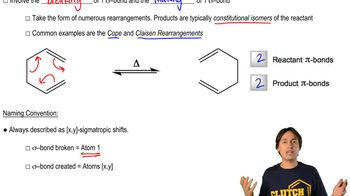
Sigmatropic rearrangements are a class of pericyclic reactions where a sigma bond and a π bond are rearranged in a concerted manner. These reactions involve the migration of a substituent across a σ bond, leading to the formation of new σ bonds and the breaking of old ones. Understanding the mechanism and the types of sigmatropic rearrangements is crucial for predicting the products of such reactions.
Recommended video:
Guided course
03:20
Nomenclature of Sigmatropic Shifts

Types of Sigmatropic Rearrangements

Sigmatropic rearrangements are categorized based on the number of atoms involved in the migration. The most common types are [1,3]- and [1,5]-sigmatropic rearrangements, where the numbers indicate the positions of the migrating atom relative to the original bond. Recognizing these types helps in identifying the specific rearrangement occurring in a given reaction.
Recommended video:
Guided course
03:20
Nomenclature of Sigmatropic Shifts

Woodward-Hoffmann Rules

The Woodward-Hoffmann rules provide a framework for predicting the stereochemical outcomes of pericyclic reactions, including sigmatropic rearrangements. These rules are based on the conservation of orbital symmetry and help determine whether a reaction will proceed under thermal or photochemical conditions. Familiarity with these rules is essential for analyzing the feasibility and mechanism of sigmatropic rearrangements.
Recommended video:
1:18
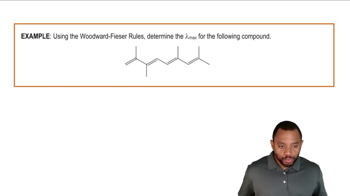
Woodward-Fieser Rules Example 1