Ch. 15 - Structural Identification II: Nuclear Magnetic Resonance Spectroscopy
Mullins - Organic Chemistry: A Learner Centered Approach 1st Edition
Mullins1st EditionOrganic Chemistry: A Learner Centered ApproachISBN: 9780137566471Not the one you use?Change textbook
Chapter 14, Problem 44

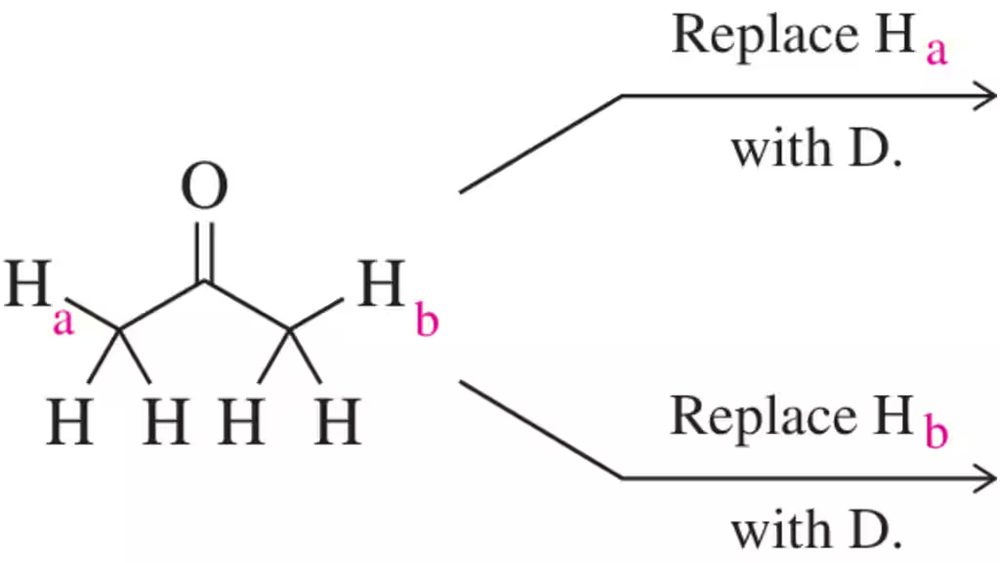
Replace Hₐ and H₆ in acetone with a deuterium. What is the relationship between the two products you obtain? Based on this, would you expect the two hydrogens to give one or two signals in the ¹H NMR spectrum?
Acetone structure showing replacement of Ha and Hb with deuterium, questioning NMR signal count.

Verified step by step guidance
1
Identify the structure of acetone: Acetone is a simple ketone with the formula (CH₃)₂CO. It consists of a central carbonyl group (C=O) flanked by two methyl groups (CH₃).
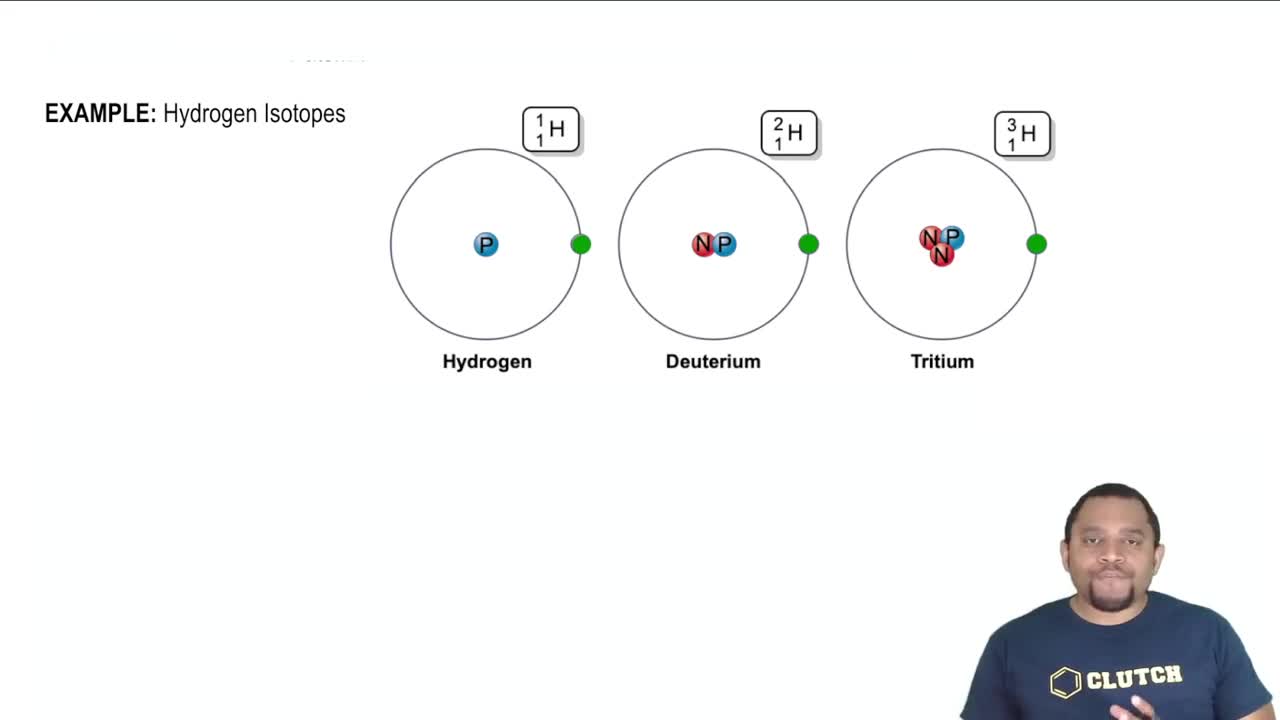
Understand the concept of deuterium substitution: Deuterium (D) is an isotope of hydrogen with one neutron. Replacing hydrogen atoms with deuterium in a molecule can affect its NMR properties.
Determine the positions of Hₐ and H₆ in acetone: In acetone, the hydrogens on the methyl groups are equivalent due to the symmetry of the molecule. Therefore, Hₐ and H₆ refer to any of the hydrogens on the methyl groups.
Consider the symmetry and equivalence in acetone: When you replace Hₐ and H₆ with deuterium, the symmetry of the molecule means that the two products are identical. This is because the methyl groups are equivalent and the substitution does not break the symmetry.
Predict the NMR signals: In ¹H NMR, equivalent hydrogens give rise to a single signal. Since the two hydrogens (Hₐ and H₆) are equivalent in acetone, replacing them with deuterium will not change this equivalence. Therefore, you would expect these hydrogens to give one signal in the ¹H NMR spectrum.

Verified video answer for a similar problem:

This video solution was recommended by our tutors as helpful for the problem above.
Video duration:
5m
Was this helpful?

Key Concepts

Here are the essential concepts you must grasp in order to answer the question correctly.

Isotopic Substitution

Isotopic substitution involves replacing an atom in a molecule with another isotope of the same element, such as replacing hydrogen (H) with deuterium (D). This substitution can affect the physical and chemical properties of the molecule, including its behavior in spectroscopic analysis, due to the difference in mass between isotopes.
Recommended video:
Guided course
03:06
Understanding the hydrogen isotopes.

Chemical Equivalence in NMR

Chemical equivalence in NMR refers to the condition where nuclei in a molecule experience the same electronic environment, resulting in a single signal in the NMR spectrum. In acetone, the two hydrogens (Hₐ and H₆) are chemically equivalent, meaning they are in identical environments and would typically produce one signal in the ¹H NMR spectrum.
Recommended video:
Guided course
11:44
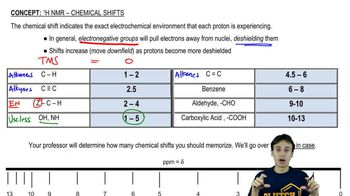
1H NMR Chemical Shifts

NMR Spectroscopy

NMR spectroscopy is a technique used to determine the structure of organic compounds by analyzing the magnetic properties of atomic nuclei. In ¹H NMR, the number of signals corresponds to the number of distinct hydrogen environments in a molecule. Isotopic substitution, such as replacing hydrogen with deuterium, can alter the NMR signals due to changes in the magnetic environment.
Recommended video:
Guided course
10:06
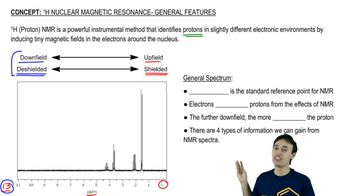
General NMR Features