Ch. 22 - Condensations and Alpha Substitutions of Carbonyl Compounds
Wade - Organic Chemistry 9th Edition
Wade9th EditionOrganic ChemistryISBN: 9780135213728Not the one you use?Change textbook
Chapter 22, Problem 71c

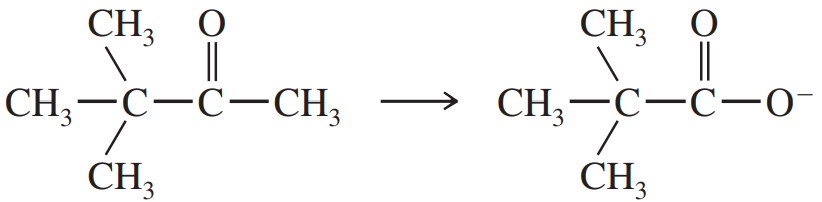
Show how you would accomplish the following conversions in good yields. You may use any necessary reagents.
(c) Chemical reaction diagram showing the conversion of a ketone to a carboxylate ion with structural formulas.

Verified step by step guidance
1
Step 1: Analyze the transformation. The starting compound is a ketone, and the product is its enolate form. This indicates that the conversion involves deprotonation of the alpha-hydrogen adjacent to the carbonyl group.
Step 2: Identify the reagent required for deprotonation. A strong base is typically used to abstract the alpha-hydrogen. Common bases include sodium hydride (NaH), lithium diisopropylamide (LDA), or sodium ethoxide (NaOEt).
Step 3: Choose the appropriate solvent. The reaction should be carried out in a polar aprotic solvent such as tetrahydrofuran (THF) or in an alcohol like ethanol, depending on the base used.
Step 4: Perform the reaction. Add the chosen base to the ketone in the solvent under controlled conditions to ensure selective deprotonation at the alpha-carbon.
Step 5: Confirm the formation of the enolate ion. The enolate ion is stabilized by resonance, where the negative charge is delocalized between the alpha-carbon and the oxygen atom of the carbonyl group.

Verified video answer for a similar problem:

This video solution was recommended by our tutors as helpful for the problem above.
Video duration:
3m
Was this helpful?

Key Concepts

Here are the essential concepts you must grasp in order to answer the question correctly.

Reaction Mechanisms

Understanding reaction mechanisms is crucial in organic chemistry as it describes the step-by-step process by which reactants transform into products. This includes identifying intermediates, transition states, and the role of catalysts. A clear grasp of mechanisms helps predict the outcome of reactions and the conditions needed for successful conversions.
Recommended video:
Guided course
02:16
Heck Reaction Mechanism

Reagents and Conditions

Different organic reactions require specific reagents and conditions to proceed effectively. Knowledge of common reagents, such as acids, bases, oxidizing agents, and reducing agents, is essential. Additionally, understanding the influence of temperature, pressure, and solvent choice can significantly affect reaction yields and selectivity.
Recommended video:

Stereochemistry

Stereochemistry involves the study of the spatial arrangement of atoms in molecules and how this affects their chemical behavior. In many organic reactions, the stereochemistry of reactants can influence the products formed, particularly in chiral molecules. Recognizing stereochemical outcomes is vital for predicting the success of conversions and ensuring desired product configurations.
Recommended video:
1:38
Polymer Stereochemistry Concept 1