Ch. 7 - Structure and Synthesis of Alkenes; Elimination
Wade - Organic Chemistry 9th Edition
Wade9th EditionOrganic ChemistryISBN: 9780135213728Not the one you use?Change textbook
Chapter 7, Problem 51d

What halides would undergo E2 dehydrohalogenation to give the following pure alkenes?
d. methylenecyclohexane

Verified step by step guidance
1
Step 1: Understand the E2 elimination mechanism. E2 dehydrohalogenation involves the removal of a hydrogen atom (β-hydrogen) and a halide ion (leaving group) from adjacent carbon atoms in a single concerted step, forming a double bond (alkene). The reaction requires a strong base and a good leaving group.
Step 2: Analyze the target alkene, methylenecyclohexane. This compound has a double bond between the cyclohexane ring and a terminal methylene group (-CH₂). This indicates that the halide precursor must have a halogen attached to the carbon adjacent to the methylene group.
Step 3: Identify the possible halide precursors. To form methylenecyclohexane via E2 elimination, the halide must be attached to the carbon adjacent to the methylene group. The precursor could be cyclohexylmethyl halides, such as cyclohexylmethyl bromide or cyclohexylmethyl chloride.
Step 4: Consider the stereoelectronic requirements of E2 elimination. The β-hydrogen and the leaving group must be anti-periplanar (opposite sides of the molecule in the same plane) for the elimination to occur. Ensure the halide precursor has this geometry to facilitate the reaction.
Step 5: Choose the halides with good leaving groups. Bromides and iodides are better leaving groups than chlorides due to their weaker bonds with carbon. Cyclohexylmethyl bromide or cyclohexylmethyl iodide would be ideal candidates for E2 dehydrohalogenation to form methylenecyclohexane.

Verified video answer for a similar problem:

This video solution was recommended by our tutors as helpful for the problem above.
Video duration:
2m
Was this helpful?

Key Concepts

Here are the essential concepts you must grasp in order to answer the question correctly.

E2 Mechanism

The E2 mechanism is a type of elimination reaction where a base removes a proton from a β-carbon while a leaving group (such as a halide) departs from the α-carbon simultaneously. This concerted process results in the formation of a double bond. Understanding the stereochemistry and the requirement for anti-periplanar geometry is crucial for predicting the outcome of E2 reactions.
Recommended video:
Guided course
09:36
Drawing the E2 Mechanism.

Dehydrohalogenation

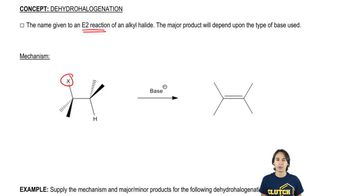
Dehydrohalogenation refers to the elimination of a hydrogen halide (HX) from an alkyl halide, leading to the formation of an alkene. This reaction is often facilitated by strong bases and is a key step in synthesizing alkenes from alkyl halides. The choice of base and the structure of the halide influence the reaction pathway and the stability of the resulting alkene.
Recommended video:
Guided course
03:02
The dehydrohalogenation mechanism.

Alkene Stability

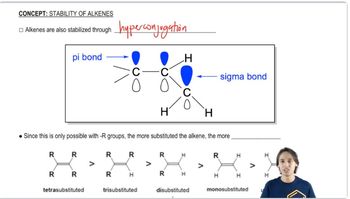
The stability of alkenes is influenced by factors such as substitution and sterics. More substituted alkenes are generally more stable due to hyperconjugation and the inductive effect. When predicting which halides will undergo E2 reactions to form specific alkenes, it is essential to consider the stability of the potential alkene products, as this can guide the selection of starting materials.
Recommended video:
Guided course
04:28
Understanding trends of alkene stability.