Draw skeletal structures for the following: b. 1,3-dimethylcyclohexane
Verified step by step guidance
1
Start by identifying the parent structure: The name 'cyclohexane' indicates that the parent structure is a six-membered cyclic ring. Draw a hexagon to represent the cyclohexane ring.
Locate the substituents: The name '1,3-dimethyl' indicates that there are two methyl groups (-CH₃) attached to the cyclohexane ring at positions 1 and 3.
Assign numbering to the ring: Choose one carbon atom in the cyclohexane ring as position 1, and number the ring sequentially in a clockwise or counterclockwise direction to ensure the substituents are at the lowest possible positions.
Add the substituents: Attach a methyl group (-CH₃) to the carbon atom labeled as position 1 and another methyl group to the carbon atom labeled as position 3.
Verify the structure: Ensure that the skeletal structure accurately represents 1,3-dimethylcyclohexane, with the correct placement of the methyl groups and the six-membered ring intact.
Verified video answer for a similar problem:
This video solution was recommended by our tutors as helpful for the problem above
Video duration:
5m
Play a video:
0 Comments
Key Concepts
Here are the essential concepts you must grasp in order to answer the question correctly.
Skeletal Structures
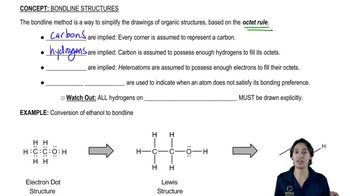
Skeletal structures, or line-angle formulas, are simplified representations of organic molecules where carbon atoms are implied at the ends of lines and at intersections. Hydrogen atoms attached to carbons are usually omitted for clarity. This notation allows chemists to visualize the molecular framework quickly, focusing on the connectivity and arrangement of atoms rather than individual bonds.
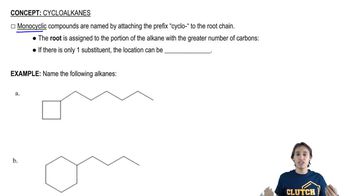
Cycloalkanes are a class of hydrocarbons characterized by carbon atoms arranged in a ring structure. They follow the general formula CnH2n, where 'n' is the number of carbon atoms. Cyclohexane, for example, consists of six carbon atoms in a ring, and its stability and reactivity can be influenced by substituents attached to the ring, such as methyl groups in the case of 1,3-dimethylcyclohexane.
Substituents are atoms or groups of atoms that replace hydrogen atoms in a hydrocarbon. In 1,3-dimethylcyclohexane, two methyl groups are attached to the cyclohexane ring at the first and third carbon positions. The arrangement of these substituents can lead to different isomers, affecting the molecule's physical and chemical properties, such as boiling point and stability.