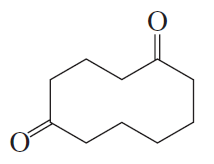
The following product was obtained from the ozonolysis of an alkene followed by treatment with dimethyl sulfide. What is the structure of the alkene? c.
Verified step by step guidance
1
Analyze the product structure obtained from ozonolysis. The image shows a cyclic compound with two carbonyl groups (C=O) located on opposite ends of the ring. This indicates that the original alkene was cleaved at the double bond, forming two carbonyl groups.
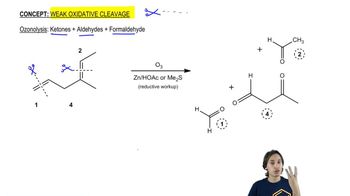
Recall the mechanism of ozonolysis. Ozone (O₃) reacts with an alkene to form an ozonide intermediate, which is then reduced by dimethyl sulfide (DMS) to yield aldehydes or ketones. In this case, the product contains two ketones, suggesting the original alkene was symmetrical.
Determine the structure of the original alkene. Since the product is a cyclic compound with two ketones on opposite ends, the original alkene must have been a cyclic compound with a double bond connecting the two carbons that now bear the ketones.
Consider the ring size and connectivity. The product is an 8-membered ring, so the original alkene must also have been an 8-membered ring with a double bond positioned symmetrically to yield the observed ketones upon cleavage.
Draw the structure of the original alkene. The double bond should be placed between the two carbons that correspond to the positions of the ketones in the product. This ensures that ozonolysis followed by reduction with DMS produces the observed product.
Verified video answer for a similar problem:
This video solution was recommended by our tutors as helpful for the problem above
Video duration:
6m
Play a video:
0 Comments
Key Concepts
Here are the essential concepts you must grasp in order to answer the question correctly.
Ozonolysis
Ozonolysis is a reaction involving the cleavage of alkenes or alkynes using ozone (O3) to form carbonyl compounds, such as aldehydes and ketones. The reaction typically proceeds through the formation of a cyclic ozonide intermediate, which is then reduced to yield the final products. Understanding ozonolysis is crucial for determining the structure of the original alkene based on the products formed.
Dimethyl sulfide (DMS) is commonly used as a reducing agent in organic chemistry, particularly in the context of ozonolysis. After the formation of ozonides, DMS can reduce these intermediates to yield carbonyl compounds. Recognizing the role of DMS in the reaction helps in predicting the final structure of the products and, consequently, the original alkene structure.
The structure of alkenes, characterized by a carbon-carbon double bond, significantly influences their reactivity in various chemical reactions, including ozonolysis. The position and substitution of the double bond determine the products formed during ozonolysis. A solid grasp of alkene structures, including stereochemistry and functional groups, is essential for deducing the original alkene from the ozonolysis products.