Ch. 7 - Structure and Synthesis of Alkenes; Elimination
Wade - Organic Chemistry 9th Edition
Wade9th EditionOrganic ChemistryISBN: 9780135213728Not the one you use?Change textbook
Chapter 7, Problem 76

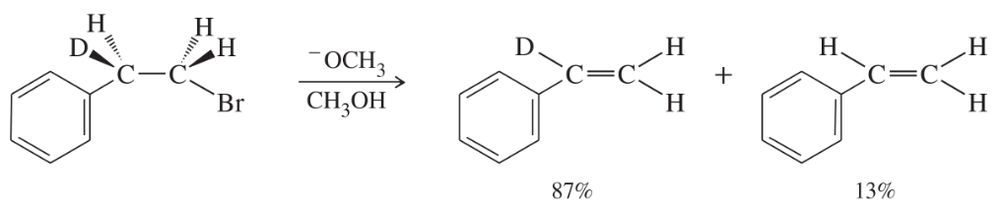
When the following compound is treated with sodium methoxide in methanol, two elimination products are possible. Explain why the deuterated product predominates by about a 7:1 ratio (refer to Problem 7-75).

Verified step by step guidance
1
Step 1: Identify the reaction type. This is an elimination reaction (E2 mechanism) where sodium methoxide (NaOCH3) in methanol acts as a strong base to abstract a proton, leading to the formation of a double bond.
Step 2: Analyze the stereochemistry of the starting material. The compound contains a deuterium (D) and hydrogen (H) on the β-carbon, which are anti-periplanar to the leaving group (Br). This stereochemical arrangement is crucial for the E2 elimination mechanism.
Step 3: Consider the kinetic isotope effect (KIE). The bond between the β-carbon and deuterium (C-D) is stronger than the bond between the β-carbon and hydrogen (C-H) due to the heavier mass of deuterium. Breaking the C-D bond requires more energy, making the elimination of deuterium slower compared to hydrogen.
Step 4: Compare the elimination pathways. The elimination of the β-hydrogen leads to the minor product (13%), while the elimination of the β-deuterium leads to the major product (87%). Despite the slower elimination of deuterium, the major product predominates because the stereochemical arrangement favors the anti-periplanar elimination of deuterium.
Step 5: Relate the observed product ratio to the kinetic isotope effect. The 7:1 ratio (87% deuterated product vs. 13% non-deuterated product) reflects the slower rate of C-D bond cleavage compared to C-H bond cleavage, consistent with the kinetic isotope effect observed in elimination reactions.

Verified video answer for a similar problem:

This video solution was recommended by our tutors as helpful for the problem above.
Video duration:
3m
Was this helpful?

Key Concepts

Here are the essential concepts you must grasp in order to answer the question correctly.

Elimination Reactions

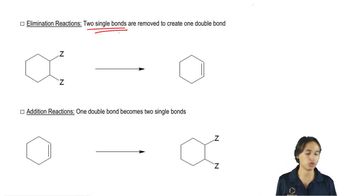
Elimination reactions involve the removal of atoms or groups from a molecule, resulting in the formation of a double bond. In this case, sodium methoxide acts as a base, facilitating the elimination of bromine and a hydrogen atom to form alkenes. Understanding the mechanism of elimination, including E2 and E1 pathways, is crucial for predicting the products and their ratios.
Recommended video:
Guided course
00:40
Recognizing Elimination Reactions.

Regioselectivity

Regioselectivity refers to the preference of a chemical reaction to yield one structural isomer over another. In this scenario, the presence of deuterium (D) influences the stability of the resulting alkenes. The more stable alkene product, which is formed preferentially, is the one that retains the deuterium, leading to a predominance of the deuterated product in the reaction.
Recommended video:
Guided course
05:09
Heck Reaction

Kinetic vs. Thermodynamic Control

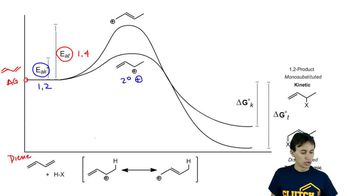
Kinetic control occurs when the product distribution is determined by the rate of formation, while thermodynamic control is based on the stability of the products. In this case, the predominance of the deuterated product suggests that the reaction is under kinetic control, where the transition state leading to the deuterated alkene is lower in energy compared to the alternative pathway, resulting in a 7:1 ratio.
Recommended video:
Guided course
08:51
Kinetic vs. Thermodynamic Control
Related Practice
Textbook Question

The following reaction is called the pinacol rearrangement. The reaction begins with an acid-promoted ionization to give a carbocation. This carbocation undergoes a methyl shift to give a more stable, resonance-stabilized cation. Loss of a proton gives the observed product. Propose a mechanism for the pinacol rearrangement.

2
views
Textbook Question

Deuterium (D) is the isotope of hydrogen of mass number 2, with a proton and a neutron in its nucleus. The chemistry of deuterium is nearly identical to the chemistry of hydrogen, except that the C―D bond is slightly (5.0 kJ/mol, or 1.2 kcal/mol) stronger than the C―H bond. Reaction rates tend to be slower if a C―D bond (as opposed to a C―H bond) is broken in a rate-limiting step. This effect on the rate is called a kinetic isotope effect. (Review Problem 4-57)

b. When the following deuterated compound reacts under the same conditions, the rate of formation of the substitution product is unchanged, while the rate of formation of the elimination product is slowed by a factor of 7.

Explain why the elimination rate is slower, but the substitution rate is unchanged.

5
views
Textbook Question

Deuterium (D) is the isotope of hydrogen of mass number 2, with a proton and a neutron in its nucleus. The chemistry of deuterium is nearly identical to the chemistry of hydrogen, except that the C―D bond is slightly (5.0 kJ/mol, or 1.2 kcal/mol) stronger than the C―H bond. Reaction rates tend to be slower if a C―D bond (as opposed to a C―H bond) is broken in a rate-limiting step. This effect on the rate is called a kinetic isotope effect. (Review PROBLEM 4-57)

a. Propose a mechanism to explain each product in the following reaction.

1
views