Which of the following molecules would you expect to have a dipole moment of zero? a. CH3CH3 b. H2C═O c. CH2Cl2
Verified step by step guidance
1
Step 1: Understand the concept of dipole moment. A dipole moment arises when there is an uneven distribution of electron density in a molecule due to differences in electronegativity between bonded atoms. A molecule will have a dipole moment of zero if it is symmetrical and the bond dipoles cancel each other out.
Step 2: Analyze molecule (a) CH3CH3 (ethane). Ethane is a nonpolar molecule because it consists of two identical CH3 groups connected by a single bond. The molecule is symmetrical, and there is no net dipole moment as the bond dipoles cancel out.
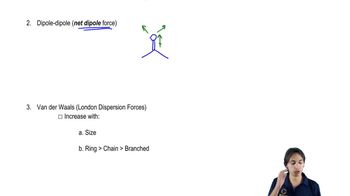
Step 3: Analyze molecule (b) H2C═O (formaldehyde). Formaldehyde contains a polar C═O bond due to the significant electronegativity difference between carbon and oxygen. The molecule is not symmetrical, so the dipole moment does not cancel out, and the molecule has a net dipole moment.
Step 4: Analyze molecule (c) CH2Cl2 (dichloromethane). Dichloromethane has two polar C-Cl bonds and two C-H bonds. The molecule is not symmetrical because the chlorine atoms are more electronegative than hydrogen, leading to an uneven distribution of electron density. Therefore, CH2Cl2 has a net dipole moment.
Step 5: Conclude that the molecule with a dipole moment of zero is (a) CH3CH3, as it is the only molecule in the list that is symmetrical and nonpolar.
Verified video answer for a similar problem:
This video solution was recommended by our tutors as helpful for the problem above
Video duration:
1m
Play a video:
0 Comments
Key Concepts
Here are the essential concepts you must grasp in order to answer the question correctly.
Molecular Polarity
Molecular polarity refers to the distribution of electrical charge across a molecule. A molecule is polar if it has a net dipole moment due to differences in electronegativity between atoms, leading to uneven charge distribution. Conversely, nonpolar molecules have symmetrical charge distributions, resulting in a dipole moment of zero.
The dipole moment is a vector quantity that measures the separation of positive and negative charges in a molecule. It is calculated as the product of the charge and the distance between the charges. A dipole moment of zero indicates that the molecule is nonpolar, meaning that the individual bond dipoles cancel each other out due to symmetry.
Symmetry plays a crucial role in determining the polarity of a molecule. Molecules with symmetrical shapes, such as linear or tetrahedral arrangements, often have their dipole moments cancel out, resulting in nonpolar characteristics. In contrast, asymmetrical molecules typically exhibit a net dipole moment, indicating polarity.