
Ch.1 - Structure and Bonding
Wade - Organic Chemistry 9th Edition
Wade9th EditionOrganic ChemistryISBN: 9780135213728Not the one you use?Change textbook
Chapter 1, Problem 47a

Compound X, isolated from lanolin (sheep’s wool fat), has the pungent aroma of dirty sweatsocks. A careful analysis showed that compound X contains 62.0% carbon and 10.4% hydrogen. No nitrogen or halogen was found.
a. Compute an empirical formula for compound X

Verified step by step guidance
1
Start by assuming you have 100 grams of compound X. This allows you to directly convert the percentage composition into grams: 62.0 grams of carbon and 10.4 grams of hydrogen.
Convert the mass of each element to moles by using their respective molar masses. For carbon, use 12.01 g/mol, and for hydrogen, use 1.008 g/mol. Calculate the moles of carbon: \( \text{moles of C} = \frac{62.0 \text{ g}}{12.01 \text{ g/mol}} \). Calculate the moles of hydrogen: \( \text{moles of H} = \frac{10.4 \text{ g}}{1.008 \text{ g/mol}} \).
Determine the simplest whole number ratio of moles of each element by dividing each by the smallest number of moles calculated in the previous step.
If the ratios are not whole numbers, multiply all ratios by the same factor to obtain whole numbers. This will give you the subscripts for the empirical formula.
Write the empirical formula using the whole number ratios as subscripts for each element. The empirical formula represents the simplest ratio of atoms in the compound.

Verified video answer for a similar problem:

This video solution was recommended by our tutors as helpful for the problem above.
Video duration:
4m
Was this helpful?

Key Concepts

Here are the essential concepts you must grasp in order to answer the question correctly.

Empirical Formula

The empirical formula of a compound represents the simplest whole-number ratio of the elements present in the compound. To determine it, convert the percentage composition of each element to moles, divide by the smallest number of moles to find the simplest ratio, and use these ratios to write the formula.
Recommended video:
Guided course
02:17
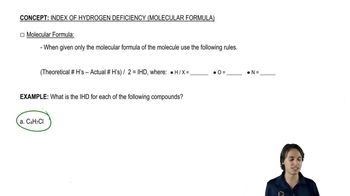
How to use IHD with molecular formula.

Mole Concept

The mole is a fundamental unit in chemistry that measures the amount of substance. It allows chemists to count particles by weighing them. To find moles from a percentage composition, divide the mass percentage by the atomic mass of the element, which helps in determining the empirical formula.
Recommended video:
1:12
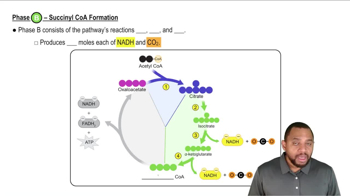
The Citric Acid Cycle Concept 3

Elemental Analysis

Elemental analysis involves determining the percentage composition of each element in a compound. This data is crucial for calculating the empirical formula, as it provides the necessary information to convert mass percentages into moles, which are then used to find the simplest ratio of elements.
Recommended video:
Guided course
06:56
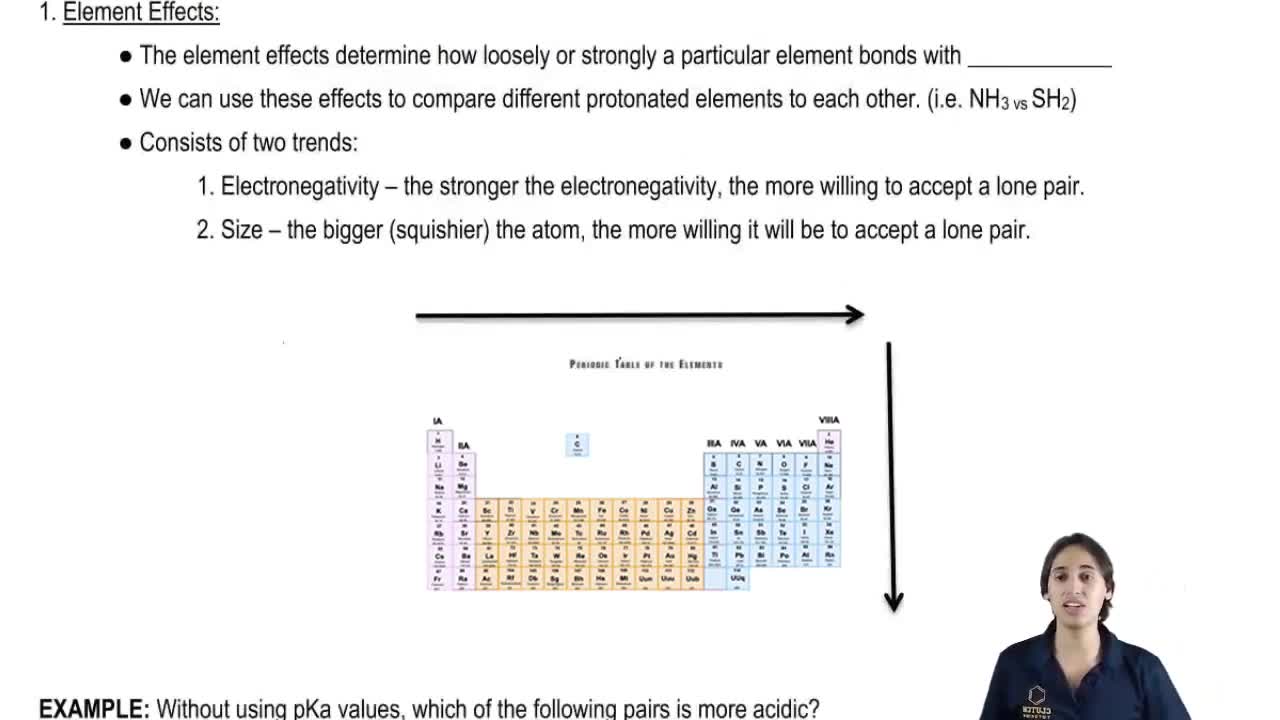
Understanding the Element Effect.
Related Practice
Textbook Question

Compound X, isolated from lanolin (sheep's wool fat), has the pungent aroma of dirty sweatsocks. A careful analysis showed that compound X contains 62.0% carbon and 10.4% hydrogen. No nitrogen or halogen was found.

b. A molecular weight determination showed that compound X has a molecular weight of approximately 117. Find the molecular formula of compound X.

1
views
Textbook Question

Use resonance structures to identify the areas of high and low electron density in the following compounds:

(a)

(b)

(c)

3
views
Textbook Question

In 1934, Edward A. Doisy of Washington University extracted 3000 lb of hog ovaries to isolate a few milligrams of pure estradiol, a potent female hormone. Doisy burned 5.00 mg of this precious sample in oxygen and found that 14.54 mg of CO2 and 3.97 mg of H2O were generated.

b. The molecular weight of estradiol was later determined to be 272. Determine the molecular formula of estradiol.

2
views
Textbook Question

Use resonance structures to identify the areas of high and low electron density in the following compounds:

g.

h.

2
views
Textbook Question

In 1934, Edward A. Doisy of Washington University extracted 3000 lb of hog ovaries to isolate a few milligrams of pure estradiol, a potent female hormone. Doisy burned 5.00 mg of this precious sample in oxygen and found that 14.54 mg of CO2 and 3.97 mg of H2O were generated.

a. Determine the empirical formula of estradiol.

2
views
Textbook Question

Use resonance structures to identify the areas of high and low electron density in the following compounds:

i.

j.

1
views