Ch. 23 - Benzene I: Aromatic Stability and Substitution Reactions
Mullins - Organic Chemistry: A Learner Centered Approach 1st Edition
Mullins1st EditionOrganic Chemistry: A Learner Centered ApproachISBN: 9780137566471Not the one you use?Change textbook
Chapter 22, Problem 93

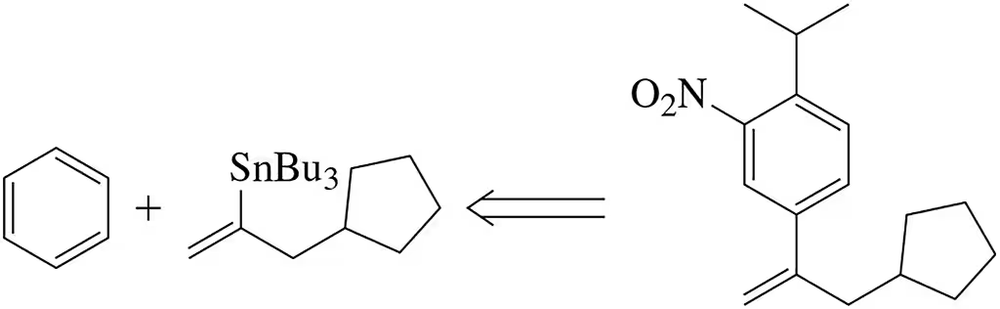
Suggest a synthesis of the molecule on the right beginning with the molecules on the left.
Chemical reaction diagram showing reactants on the left and product on the right, with a tin compound and a nitro group.

Verified step by step guidance
1
Identify the reaction type: The transformation involves a coupling reaction, likely a Stille coupling, given the presence of the organotin compound (SnBu3) and the formation of a new carbon-carbon bond.
Recognize the reagents: The starting materials include a phenyl group and a vinylstannane. The target molecule has a nitro group (O2N) on the aromatic ring, suggesting the need for a nitration step.
Plan the coupling reaction: Use a palladium catalyst to facilitate the Stille coupling between the phenyl group and the vinylstannane, forming the new carbon-carbon bond.
Introduce the nitro group: After the coupling reaction, perform a nitration of the aromatic ring using a mixture of concentrated nitric acid (HNO3) and sulfuric acid (H2SO4) to introduce the nitro group at the para position.
Verify the structure: Ensure that the final product matches the target molecule, with the correct placement of the nitro group and the newly formed carbon-carbon bond.

Verified video answer for a similar problem:

This video solution was recommended by our tutors as helpful for the problem above.
Video duration:
5m
Was this helpful?

Key Concepts

Here are the essential concepts you must grasp in order to answer the question correctly.

Retrosynthetic Analysis

Retrosynthetic analysis is a strategy used in organic chemistry to deconstruct a target molecule into simpler precursor structures. This method involves identifying functional groups and breaking down the molecule into smaller, more manageable components, allowing chemists to plan a synthetic route. It emphasizes the importance of understanding how different reactions can be applied to achieve the desired molecular structure.
Recommended video:
Guided course
01:22
Retrosynthesis

Functional Groups

Functional groups are specific groups of atoms within molecules that are responsible for the characteristic chemical reactions of those molecules. Recognizing functional groups is crucial for predicting reactivity and determining the appropriate synthetic pathways. Common functional groups include alcohols, amines, and carboxylic acids, each influencing the molecule's behavior in reactions.
Recommended video:
Guided course
02:36
Identifying Functional Groups

Reaction Mechanisms

Reaction mechanisms describe the step-by-step process by which reactants transform into products during a chemical reaction. Understanding these mechanisms is essential for predicting the outcomes of reactions and for designing synthetic routes. Key concepts include nucleophiles, electrophiles, and the role of intermediates, which help in visualizing how bonds are formed and broken throughout the reaction.
Recommended video:
Guided course
02:16
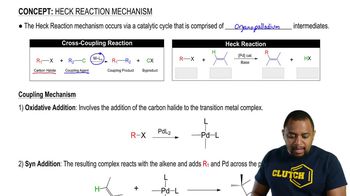
Heck Reaction Mechanism