Ch. 24 - Benzene II: Reactions Influenced by the Aromatic Ring
Mullins - Organic Chemistry: A Learner Centered Approach 1st Edition
Mullins1st EditionOrganic Chemistry: A Learner Centered ApproachISBN: 9780137566471Not the one you use?Change textbook
Chapter 23, Problem 66

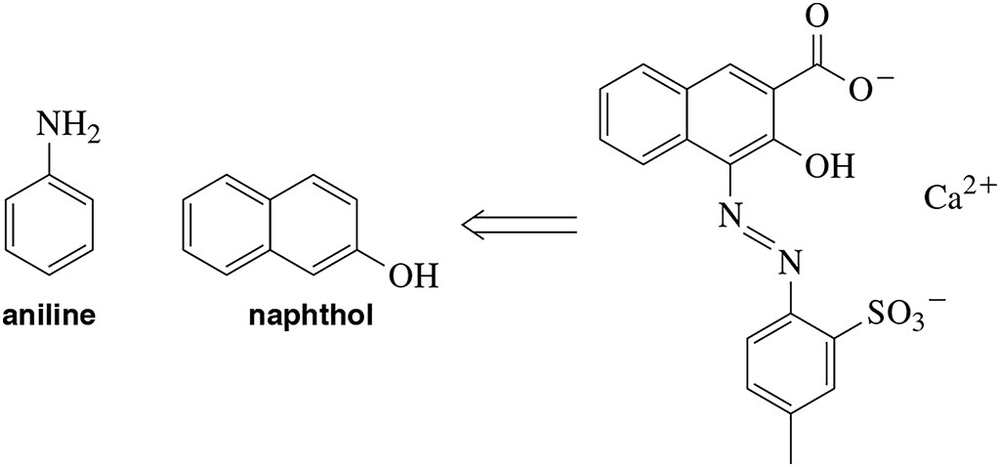
Synthesize the dye shown starting with aniline and naphthol using reactions from Chapters 23 and 24. [Hint. Start by identifying how each substituent might be installed and then plan the order of their introduction.]

Verified step by step guidance
1
Identify the functional groups in the target dye molecule: a carboxylate group, a sulfonate group, and an azo linkage. The starting materials are aniline and naphthol.
Begin with the diazotization of aniline. Convert the amino group of aniline to a diazonium salt by treating it with nitrous acid (HNO2) in the presence of hydrochloric acid (HCl). This forms the diazonium ion, which is a key intermediate for azo coupling.
Perform azo coupling between the diazonium salt and naphthol. The naphthol acts as a nucleophile and attacks the diazonium ion, forming the azo linkage (N=N) between the two aromatic rings.
Introduce the sulfonate group by sulfonation of the aromatic ring. This can be achieved by treating the azo compound with sulfuric acid (H2SO4) to install the sulfonate group (SO3-) on the aromatic ring.
Finally, introduce the carboxylate group by carboxylation. This can be done by treating the naphthol moiety with carbon dioxide (CO2) under basic conditions to form the carboxylate group (COO-), which can then be neutralized with calcium ions (Ca2+) to form the calcium salt.

Verified video answer for a similar problem:

This video solution was recommended by our tutors as helpful for the problem above.
Was this helpful?

Key Concepts

Here are the essential concepts you must grasp in order to answer the question correctly.

Amino Group Reactivity

The amino group (-NH2) in aniline is a strong nucleophile, making it highly reactive in electrophilic aromatic substitution reactions. Understanding how to introduce substituents onto the aromatic ring of aniline is crucial, as the amino group can direct new substituents to ortho and para positions, influencing the overall structure of the final dye.
Recommended video:
Guided course
09:36
Standard Amino Acids

Naphthol Chemistry

Naphthol, which contains a hydroxyl group (-OH) on a naphthalene ring, can participate in various reactions, including electrophilic substitutions and coupling reactions. The position of the hydroxyl group affects its reactivity and the types of reactions it can undergo, making it essential to consider when planning the synthesis of the dye.
Recommended video:
Guided course
00:28
Introduction to General Chemistry Review

Dye Formation Mechanism

The synthesis of dyes often involves coupling reactions between aromatic amines and phenolic compounds. Understanding the mechanism of these reactions, including the formation of azo bonds and the role of catalysts or conditions, is vital for successfully synthesizing the desired dye structure from aniline and naphthol.
Recommended video:
Guided course
02:26
Formation of Enolates