Ch. 7 - The Reactions of Alkynes • An Introduction to Multistep Synthesis
Bruice - Organic Chemistry 8th Edition
Bruice8th EditionOrganic ChemistryISBN: 9780135213711Not the one you use?Change textbook
Chapter 8, Problem 37c

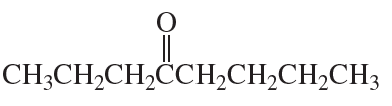
How can the following compounds be synthesized, starting with a hydrocarbon that has the same number of carbons as the desired product?
c. Chemical structure of an alkane with a carbonyl group, illustrating alkyne hydration synthesis.

Verified step by step guidance
1
Identify the target compound and determine its functional group(s) and structure. This will help in deciding the synthetic pathway.
Determine the hydrocarbon starting material that has the same number of carbons as the target compound. For example, if the target compound has six carbons, start with a six-carbon hydrocarbon such as hexane or benzene.
Analyze the functional group transformations required to convert the hydrocarbon into the target compound. For instance, if the target compound contains an alcohol group, you may need to perform an oxidation or reduction reaction.
Plan the sequence of reactions needed to introduce the functional groups. For example, if the target compound is a ketone, you might first oxidize an alcohol or perform a Friedel-Crafts acylation.
Consider the reagents and conditions required for each step of the synthesis. For example, use reagents like PCC for oxidation, or Grignard reagents for carbon-carbon bond formation, ensuring the reaction conditions are compatible with the functional groups present.

Verified video answer for a similar problem:

This video solution was recommended by our tutors as helpful for the problem above.
Video duration:
6m
Was this helpful?

Key Concepts

Here are the essential concepts you must grasp in order to answer the question correctly.

Hydrocarbon Structure

Hydrocarbons are organic compounds consisting solely of hydrogen and carbon atoms. Understanding their structure is crucial for synthesis, as the arrangement of these atoms determines the reactivity and properties of the compound. The number of carbon atoms in the hydrocarbon must match the desired product to ensure that all necessary carbon skeletons are available for further functionalization.
Recommended video:
Guided course
04:52
Aromaticity of Hydrocarbons

Functional Group Transformation

Functional groups are specific groups of atoms within molecules that are responsible for the characteristic chemical reactions of those molecules. In organic synthesis, transforming one functional group into another is a common strategy to create desired compounds. Recognizing how to manipulate these groups is essential for synthesizing complex molecules from simpler hydrocarbons.
Recommended video:
Guided course
02:36
Identifying Functional Groups

Reaction Mechanisms

A reaction mechanism describes the step-by-step process by which reactants are converted into products. Understanding these mechanisms is vital for predicting the outcomes of chemical reactions and for designing synthetic pathways. Knowledge of mechanisms allows chemists to identify the necessary reagents and conditions to achieve the desired transformations in the synthesis of organic compounds.
Recommended video:
Guided course
02:16
Heck Reaction Mechanism